

Austenitic materials
Austenitic materials are steels or alloys whose microstructure consists predominantly of austenite. Austenite is a face-centred cubic mixed crystal structure of iron, which is stabilised down to room temperature by alloying elements such as nickel, manganese, nitrogen and carbon. Typical examples are austenitic stainless steels. They contain at least around 17% chromium and often 8% or more nickel; additions of molybdenum and nitrogen further increase corrosion resistance. Austenitic stainless steels are tough, ductile and easily formable. They are easy to weld and are largely non-magnetic in the solution-annealed condition. Unlike martensitic steels, they cannot be hardened by conventional quenching; strength and hardness are primarily controlled through work hardening and alloy design.
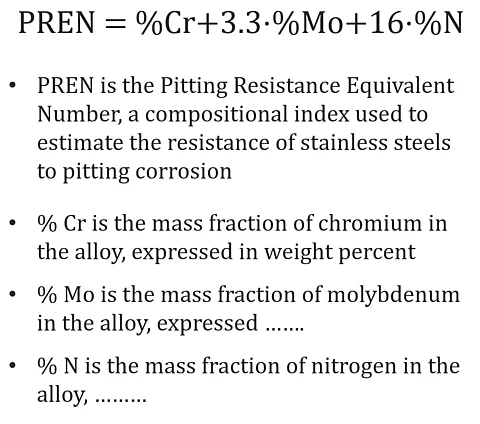
A key characteristic of austenitic stainless steels is their high resistance to pitting corrosion, particularly in chloride-containing media. This is often estimated using the Pitting Resistance Equivalent Number (PREN):
PREN = %Cr + 3,3⋅ % Mo + 16⋅ %N
Here, %Cr, %Mo and %N represent the mass fractions of chromium, molybdenum and nitrogen in the alloy. Generally speaking, the higher the PREN number, the greater the expected resistance to pitting corrosion.
Steels with PREN values above approximately 24–25 are considered to offer good resistance to pitting corrosion in many process media. Superaustenitic alloys achieve significantly higher values and are used in particularly aggressive environments. Austenitic materials are essential for the construction of mixers, dryers and reactors in the food, pharmaceutical and chemical industries.