

Gentle mixing, precise distribution: Mixing technology for muesli and cereal production
Muesli and cereal mixing is complex due to diverse particle sizes and fragile ingredients, requiring gentle yet highly uniform distribution and even incorporation of liquids without clumping. amixon’s precision mixers achieve ideal homogeneity in 10–30 seconds with minimal shear, offer up to 99.99% emptying, rapid CIP/COP cleaning, and multiple configurations (twin‑shaft, conical, gyratory, spherical, KoneSlid) to suit varying batch sizes and sensitivities, all compliant with EHEDG/FDA/GMP standards. A Paderborn technical center enables real-material trials, and a case study highlights scalable, hygiene-compliant production for an organic manufacturer.
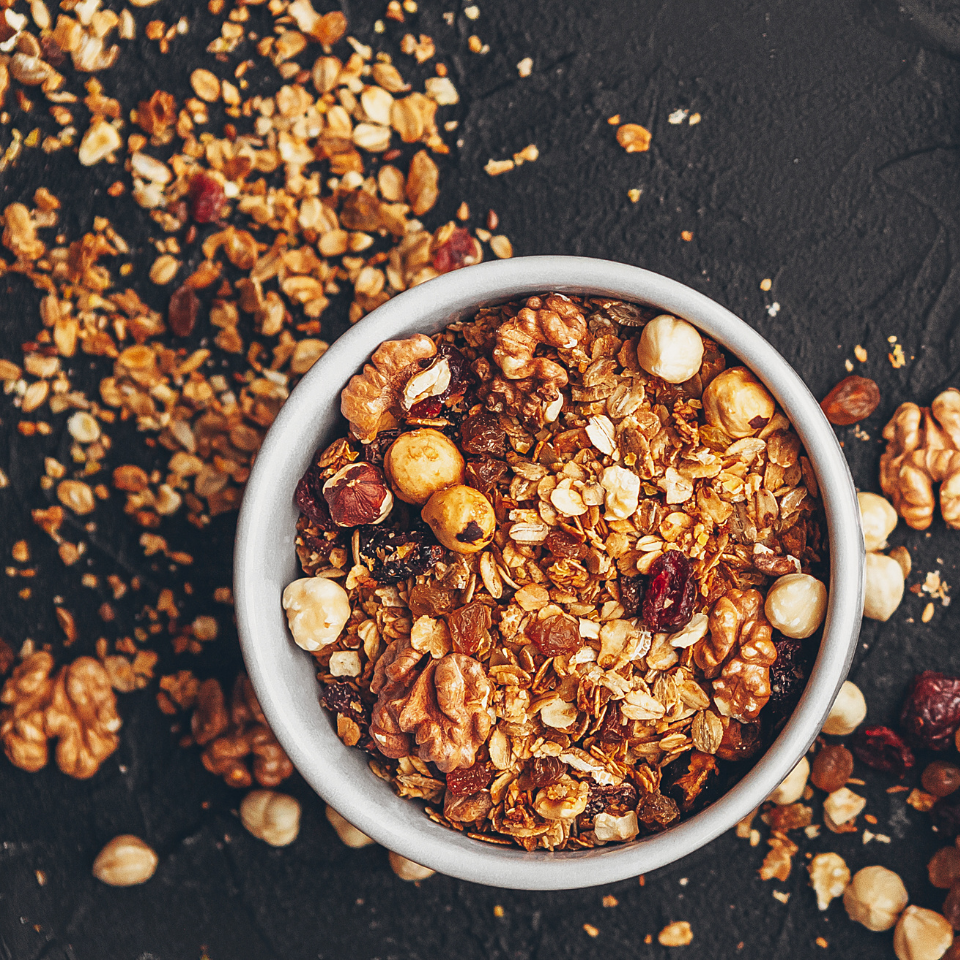
From a processing standpoint, muesli is more complex than its rustic image might suggest.
Industrial food mixers for muesli, cereals, and seed mixes
From a processing standpoint, muesli is more complex than its rustic image might suggest. The combination of rolled oats, seeds, nuts, chocolate chips, and dried fruit results in a mixture with widely varying particle sizes, bulk densities, and mechanical sensitivities—and that is precisely what makes the mixing process the critical link between raw materials and a premium product.
What makes the mixing process so challenging?
For muesli and cereal manufacturers, there is one essential rule: After mixing, the product should look exactly like its ingredients did before—only evenly distributed. Nuts must not break, dried fruits must not be crushed, and delicate freeze-dried fruits must retain their structure completely. At the same time, the mixture must be homogeneous: oats, raisins, and almonds must be distributed so that the consumer experiences the full flavor with every spoonful.
Contract manufacturers face additional challenges: frequent formula changes, rapid residue-free cleaning without cross-contamination, and varying batch sizes while maintaining consistent quality. In addition, liquid ingredients such as honey, syrup, or natural sweetening agents are often used, which must be finely and evenly incorporated into dry ingredients—without clumping or sticking.
For muesli and cereal manufacturers, there is one essential rule: After mixing, the product should look exactly like its ingredients did before—only evenly distributed. Nuts must not break, dried fruits must not be crushed, and delicate freeze-dried fruits must retain their structure completely. At the same time, the mixture must be homogeneous: oats, raisins, and almonds must be distributed so that the consumer experiences the full flavor with every spoonful.
Contract manufacturers face additional challenges: frequent formula changes, rapid residue-free cleaning without cross-contamination, and varying batch sizes while maintaining consistent quality. In addition, liquid ingredients such as honey, syrup, or natural sweetening agents are often used, which must be finely and evenly incorporated into dry ingredients—without clumping or sticking.
The key figure: 10 to 30 seconds
What’s surprising about cereal production: The actual mixing time is often only 10 to 30 seconds. This short duration isn’t a compromise, but a deliberate method—the shorter and gentler the mixing process, the less mechanical stress is placed on the raw materials and the higher the quality of the final product will be.
After just 20 to 160 mixing cycles, amixon® precision mixers achieve mixing results that cannot be further improved in practice. The energy input required is so low that virtually no particle breakage occurs—a 2-cubic-meter batch can be homogenized in just 15 seconds.
What’s surprising about cereal production: The actual mixing time is often only 10 to 30 seconds. This short duration isn’t a compromise, but a deliberate method—the shorter and gentler the mixing process, the less mechanical stress is placed on the raw materials and the higher the quality of the final product will be.
After just 20 to 160 mixing cycles, amixon® precision mixers achieve mixing results that cannot be further improved in practice. The energy input required is so low that virtually no particle breakage occurs—a 2-cubic-meter batch can be homogenized in just 15 seconds.
amixon® food mixers for cereal production
Depending on the batch size, formulation, and sensitivity of the product, different amixon® machine types are utilized. The following overview shows the systems and their respective strengths:
Machine type Principle Typical application Particular benefit HM – Vertical twin-shaft mixer Two coaxial spiral mixing tools Large batches, custom formulations Extremely short mixing times, variable fill levels from 15% to 100% AM – Conical single-shaft mixer Conical chamber with central mixing tool Contract manufacturing, organic seed mixes Empties up to 99.99%, minimal cleaning required GM – Gyraton®-mixer Tumbling motion in a large container Batches ranging from 10 to 100 cubic meters Maximum scalability while maintaining product integrity SH – Spherhelics®-mixer Spherical mixing chamber geometry Delicate ingredients Low shear forces, good visual product quality KS - KoneSlid® mixer Conical chamber with conical outlet High hourly output; up to 15 batches per hour are possible Very short discharge times of just a few seconds, complete emptying, minimal shear forces
All machine designs comply with EHEDG and FDA requirements and meet GMP standards for the hygienic processing of fragile food products.
Depending on the batch size, formulation, and sensitivity of the product, different amixon® machine types are utilized. The following overview shows the systems and their respective strengths:
| Machine type | Principle | Typical application | Particular benefit |
|---|---|---|---|
| HM – Vertical twin-shaft mixer | Two coaxial spiral mixing tools | Large batches, custom formulations | Extremely short mixing times, variable fill levels from 15% to 100% |
| AM – Conical single-shaft mixer | Conical chamber with central mixing tool | Contract manufacturing, organic seed mixes | Empties up to 99.99%, minimal cleaning required |
| GM – Gyraton®-mixer | Tumbling motion in a large container | Batches ranging from 10 to 100 cubic meters | Maximum scalability while maintaining product integrity |
| SH – Spherhelics®-mixer | Spherical mixing chamber geometry | Delicate ingredients | Low shear forces, good visual product quality |
| KS - KoneSlid® mixer | Conical chamber with conical outlet | High hourly output; up to 15 batches per hour are possible | Very short discharge times of just a few seconds, complete emptying, minimal shear forces |
All machine designs comply with EHEDG and FDA requirements and meet GMP standards for the hygienic processing of fragile food products.
Case Study: From Organic Food Production to Industrial Mass Manufacturing
Many organic cereal manufacturers face the same dilemma: their product range is expanding, batch sizes vary widely—and the mixing technology must handle both with equal reliability. A long-established organic food company made these exact requirements a top priority when selecting machinery:
- Ideal mixing quality with short mixing times
- A secure process that protects the product
- Variable filling levels without quality loss
- Residual emptying of up to 99.99%
- Optional dry or wet cleaning (CIP/COP-compatible)
The solution was an amixon® mixing system that enabled scalable operation from day one—while fully maintaining product integrity and ensuring complete compliance with hygiene standards.
Learn more in our white paper!
Many organic cereal manufacturers face the same dilemma: their product range is expanding, batch sizes vary widely—and the mixing technology must handle both with equal reliability. A long-established organic food company made these exact requirements a top priority when selecting machinery:
- Ideal mixing quality with short mixing times
- A secure process that protects the product
- Variable filling levels without quality loss
- Residual emptying of up to 99.99%
- Optional dry or wet cleaning (CIP/COP-compatible)
The solution was an amixon® mixing system that enabled scalable operation from day one—while fully maintaining product integrity and ensuring complete compliance with hygiene standards.
Learn more in our white paper!
The technical center as a planning tool
For manufacturers and contract manufacturers looking to set up a new mixing process or optimize existing production facilities, the amixon® Technical Center in Paderborn offers testing capabilities using original raw materials. This allows for a true-to-scale evaluation of mixing quality, liquid addition, product protection, and discharge behavior—before investing in a production facility. This reduces planning risks.
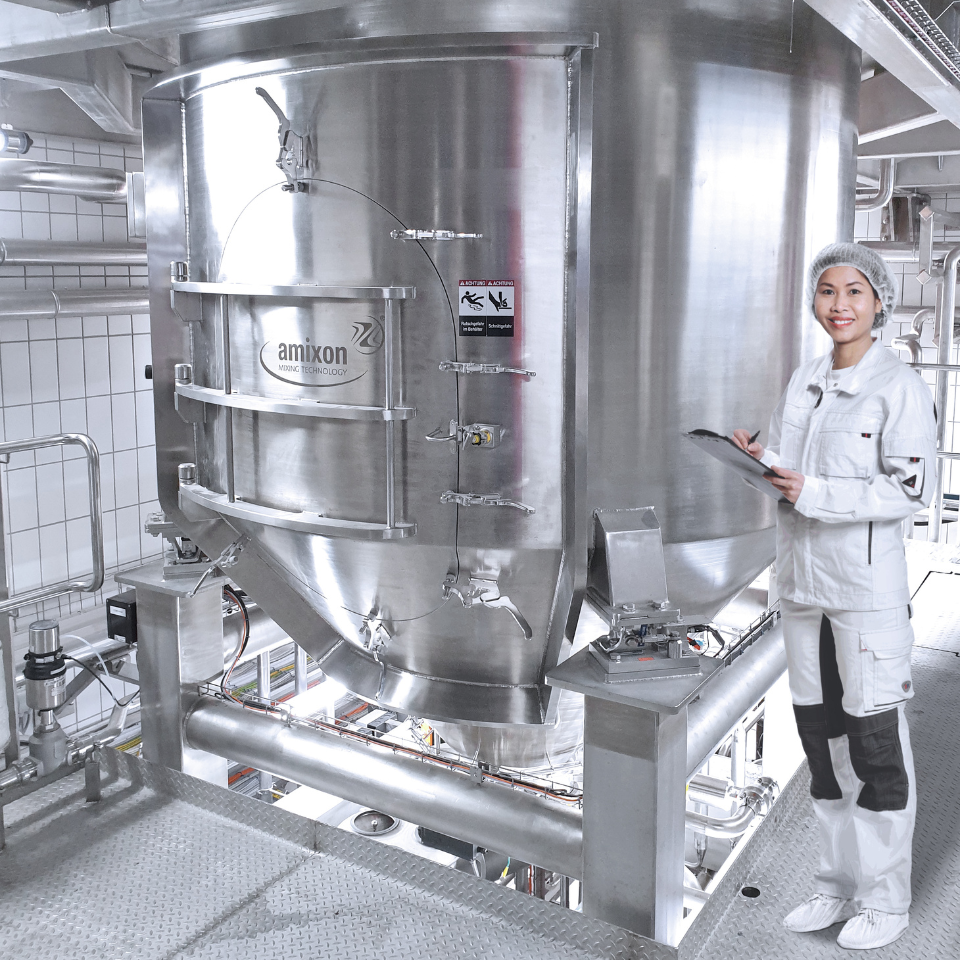
The amixon® cone mixer is also available as a test device in the technical center.
For manufacturers and contract manufacturers looking to set up a new mixing process or optimize existing production facilities, the amixon® Technical Center in Paderborn offers testing capabilities using original raw materials. This allows for a true-to-scale evaluation of mixing quality, liquid addition, product protection, and discharge behavior—before investing in a production facility. This reduces planning risks.
The amixon® cone mixer is also available as a test device in the technical center.
FAQ: Food Mixers for Muesli and Cereals
Which mixer is best suited for gentle muesli production?
Vertical twin-shaft mixers (amixon® HM) and conical single-shaft mixers (amixon® AM) are particularly well-suited for industrial muesli production, as they achieve homogeneous mixing with minimal shear forces—even when processing fragile ingredients such as nuts or freeze-dried fruits.
How short can the mixing time be in cereal production?
In industrial muesli and cereal production, the optimal mixing time is 10 to 30 seconds. amixon® mixers achieve technically ideal mixing results after just 20 to 160 rotations of the mixing blades.
What should contract manufacturers pay particular attention to when using mixing systems for muesli?
Contract manufacturers require mixing systems that can be emptied almost completely (up to 99.99%), are quick to clean (CIP/COP), and allow for variable fill levels—so they can switch recipes without cross-contamination or loss of quality.
How is liquid coating—for example, with honey or syrup—applied in cereal production?
Liquid ingredients such as honey, syrup, or sweetening agents are added directly into the ongoing mixing process via integrated injection systems. amixon® food mixers are designed for this combined dry/liquid mixing process and, thanks to their gentle product movement, prevent clumping and uneven coating.
Which mixer is best suited for gentle muesli production?
Vertical twin-shaft mixers (amixon® HM) and conical single-shaft mixers (amixon® AM) are particularly well-suited for industrial muesli production, as they achieve homogeneous mixing with minimal shear forces—even when processing fragile ingredients such as nuts or freeze-dried fruits.
How short can the mixing time be in cereal production?
In industrial muesli and cereal production, the optimal mixing time is 10 to 30 seconds. amixon® mixers achieve technically ideal mixing results after just 20 to 160 rotations of the mixing blades.
What should contract manufacturers pay particular attention to when using mixing systems for muesli?
Contract manufacturers require mixing systems that can be emptied almost completely (up to 99.99%), are quick to clean (CIP/COP), and allow for variable fill levels—so they can switch recipes without cross-contamination or loss of quality.
How is liquid coating—for example, with honey or syrup—applied in cereal production?
Liquid ingredients such as honey, syrup, or sweetening agents are added directly into the ongoing mixing process via integrated injection systems. amixon® food mixers are designed for this combined dry/liquid mixing process and, thanks to their gentle product movement, prevent clumping and uneven coating.
Conclusion
In muesli and cereal production, the mixer is not just a standard piece of equipment, but a system that is critical to quality. amixon® offers a proven food mixer for every type of production—from specialized organic manufacturers to industrial contract mixers—that excels in recipe versatility, gentle processing, hygiene, and efficiency all at once.
Learn more about the benefits of amixon® mixers for muesli and cereals in our fact sheet!
In muesli and cereal production, the mixer is not just a standard piece of equipment, but a system that is critical to quality. amixon® offers a proven food mixer for every type of production—from specialized organic manufacturers to industrial contract mixers—that excels in recipe versatility, gentle processing, hygiene, and efficiency all at once.
Learn more about the benefits of amixon® mixers for muesli and cereals in our fact sheet!
 Related News
© Copyright by amixon GmbH