
Trajectories
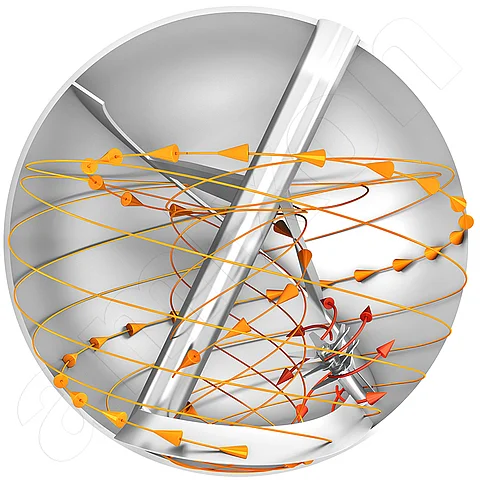
In mixing and process engineering, motion paths are the trajectories of individual particles or particle groups that arise from the superimposed flows and tool movements in the mixing chamber. Together they constitute the macroscopic flow pattern (for example kettle flow or circulating flow) as well as the microscopic relative motions. The latter are ultimately responsible for mass transfer between the different mixing zones.
In amixon® powder mixers, the bulk material typically follows a three-dimensional kettle flow: The product is conveyed upward in a spiral along the vessel wall, flows inward at the surface, and sinks back down in the center. The trajectories of individual particles thus pass through all areas of the mixing chamber at recurring intervals. Local eddies and relative motions are superimposed on this main flow and generate the mixing required for a high mixing quality, while the particle structure is treated gently.
 Blog
Blog