

strain gauge
A strain gauge usually consists of a fine metallic measuring grid applied to a carrier foil system. When the component is stretched or compressed, the measuring grid stretches or compresses with it, causing its electrical resistance to change in proportion to the strain. This change in resistance is recorded in a measuring bridge circuit (e.g. Wheatstone bridge) and converted into strain, force, torque or pressure.
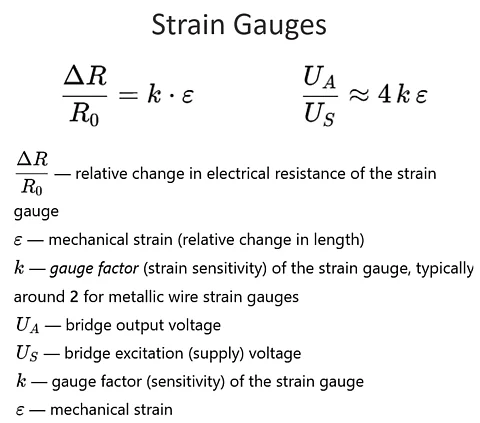
For strain gauges, the key relationship is the link between strain and relative resistance change:
ΔR/R0 = k⋅ ε
- ΔR/R0 is the relative resistance change of the strain gauge.
- ε is the mechanical elongation (relative change in length)
- k is the k factor (strain sensitivity) of the strain gauge
In bulk material and mixing technology, strain gauges can be used, for example, to measure forces on supports, flanges or shafts in order to indirectly monitor fill levels via weight, torques of mixing shafts or forces during discharge malfunctions. In this way, strain gauge-based measuring systems provide valuable process data that can be used to monitor and control mixing, conveying and filling processes and optimise them in terms of safety and energy efficiency.
For a full bridge with identical strain gauges and small strain, a good approximation is:
UA / US ≈ k · ε / 4
- UA is the bridge output voltage
- US is the supply voltage of the bridge
 Blog
Blog