

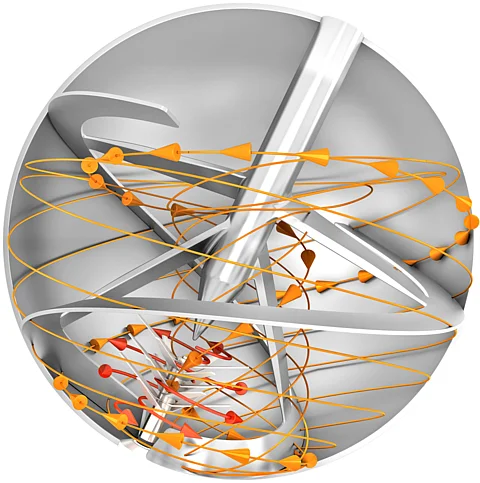
Shear stress
Shear stress refers to the mechanical stress exerted on powders, granulates or bulk materials by tangential forces. These forces cause relative movements between particles or between particles and equipment surfaces. It occurs in particular during processes such as mixing, conveying, dosing, agglomeration or comminution.
Shear stress is described by the shear strain τ, which is defined as force per unit area. For continuous media and effective particle aggregates, the following approximation may apply:
τ = μeff ⋅ γ˙
- μeff is the effective viscosity
- γ˙ is the shear rate
In dry powder systems, however, the effective viscosity is not a material constant, but a modelled parameter that describes the resistance behaviour of the particle aggregate to shear. It depends on the compaction state, the particle structure, friction and the process conditions.
In powder technology, shear stresses have a significant influence on the particle structure and product properties. High shear stresses can lead to deagglomeration, particle fragmentation, dust formation, segregation or surface activation. Sensitive products such as crystals, coated particles or brittle granules react particularly sensitively to shear stress.