
Shear crystallisation
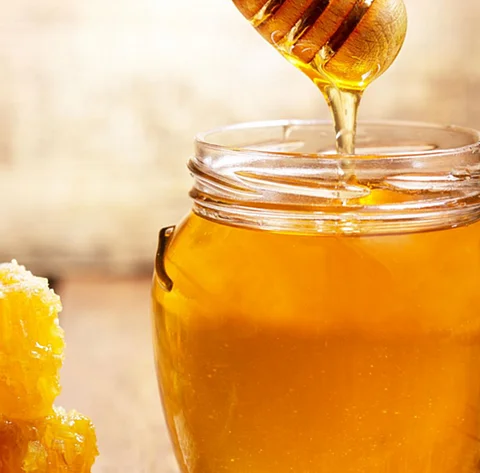
Shear crystallisation is used, amongst other things, in food technology to selectively crystallise liquid honey. Controlled shear stress during stirring or pumping promotes nucleation, resulting in fine-crystalline, spreadable honey. In this process, the shear stress influences the crystal size and texture of the final product.
Shear crystallisation refers to the formation or transformation of crystals. It results from mechanical shear stress. Shear forces can trigger nucleation in liquids, suspensions or paste-like systems. This is followed by crystal growth or the formation of the crystal structure.
Shear crystallisation can also occur in bulk materials. High shear forces can promote the nucleation rate, alter the distribution of crystal sizes and influence the morphology of the crystals. This has a major impact on product properties such as solubility, flow behaviour, texture or filterability.
It is even possible to calculate the nucleation rate. The general nucleation rate is:
J = J₀ exp (−ΔG*/(kT))
- J is the nucleation rate [1/(m³·s)]
- J₀ is the pre-exponential factor
- ΔG* is the free activation energy of nucleation
- k is the Boltzmann constant
- T is the temperature [K]
In powder technology, shear crystallisation plays a role particularly in the production of crystalline solids from solutions or melts.
 Blog
Blog