Residual discharge rate
The residual discharge rate indicates how completely a process apparatus empties itself automatically, i.e. without manual intervention. It represents the proportion of the product that remains in the system following an automatic discharge process. It is a relative figure that relates the discharged product quantity to the batch quantity. Formally, the residual discharge rate can be expressed as follows:
Residual discharge rate [%] = (1 − residual quantity / batch quantity) × 100
A high residual discharge rate means that only very small amounts of product remain in the mixing chamber, the discharge zone or in the attachments.
In powder mixing and processing, the residual discharge rate is a crucial performance parameter. It directly influences the cleaning effort, the duration of product changes, product losses and the risk of cross-contamination. Whilst the residual quantity describes an absolute value, the residual discharge rate represents a comparable metric that can be used to evaluate different systems, sizes or design principles. Terms such as ‘carry-over’ or ‘product carry-over’ describe the effects of remaining residues on subsequent batches, the cause of which can be quantified via the residual discharge rate.
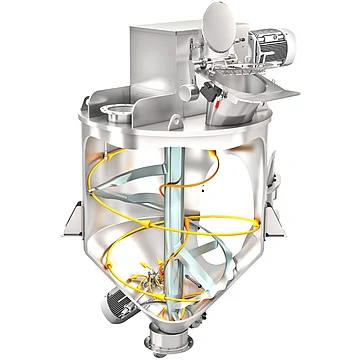
The achievable residual discharge rate is determined by numerous factors, including the geometry of the mixing chamber, the design of the discharge and transitions, the surface finish, and the flow properties of the product. The mixing and discharge principle employed also plays a significant role.
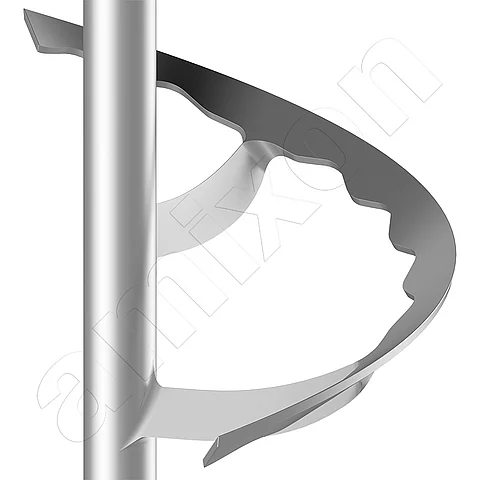
amixon® takes the residual discharge rate into account right from the development and design phase. This is how the SinConvex®, SinConcave® and ComDisc® systems were developed and brought to market. The aim is to achieve an exceptionally high discharge rate through targeted design measures, thereby sustainably minimising cleaning effort, downtime and product losses. In practice, residual discharge rates of up to 99.98% can be achieved with large amixon® mixers. This corresponds to a residual content of just 0.02%.

 Blog
Blog

 Related pages