Production scale
The term ‘production scale’ is used colloquially. It describes the transfer of a result developed in the laboratory into a technically and economically viable industrial application. In this process, processes are scaled up step by step from small quantities of material to large throughputs. At laboratory scale, experiments typically take place in the gram to milligram range.
The aim is to conduct fundamental investigations into material properties, reactions or mixing behaviour. However, conclusions regarding industrial feasibility are only possible to a limited extent at this scale.
The pilot plant scale represents an intermediate step. Here, batches of approximately 1 to 500 kg are processed. At this scale, real process conditions, energy inputs and mechanical stresses can be replicated. Pilot plant trials provide the crucial data for scale-up. Dimensionless parameters are frequently used for this purpose, in particular the Reynolds number (Re) and the Froude number (Fr). The Reynolds number describes the ratio of inertial forces to viscous forces and is an important criterion for assessing flow and mixing behaviour. The Froude number is primarily used for rotating apparatus and systems with free surfaces, as it represents the ratio of inertial forces to gravitational forces.
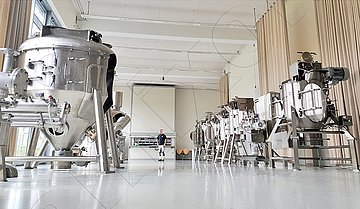
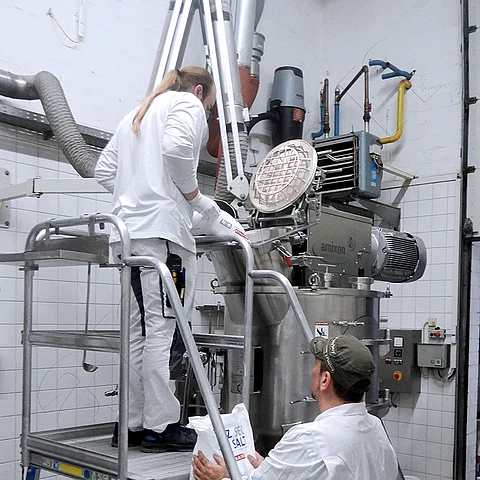
The industrial production scale involves throughput rates of several tonnes per hour. At this scale, the focus is on process stability, reproducibility, cost-effectiveness and plant availability. Without prior pilot plant trials, laboratory results cannot be directly transferred to this scale. For processing machines such as mixers, vacuum mixing dryers, contact dryers, synthesis reactors, agglomerators and deagglomerators, amixon® offers a wide range of pilot and industrial machines for testing. This allows processes to be investigated under realistic conditions and scaled up step by step.
Reliable upscaling is only possible if results from practical pilot plant trials are available. Only these allow for a realistic extrapolation or simulation of industrial processes. The production scale is thus achieved not purely through calculation, but through experimental validation.
 FAQ - Production scale
 Blog
Blog