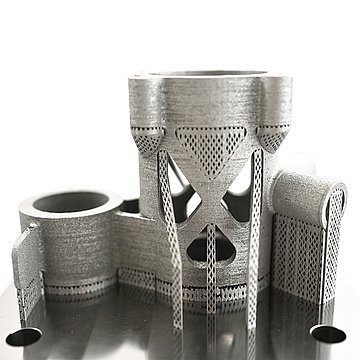

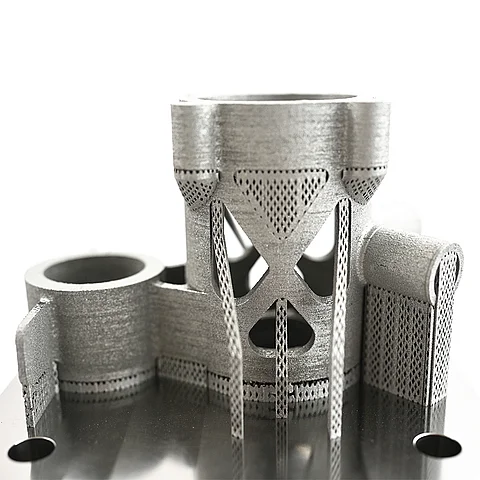
Powder bed fusion
The process is based on the localised and selective melting of a thinly applied powder bed. Energy is typically delivered by a laser beam or an electron beam. Only the areas that form part of the component are solidified; the surrounding powder remains loose and serves as a support material.
Once solidified, a new layer of powder is applied. This cycle is repeated until the three-dimensional component is fully built up. The geometry is generated directly from a digital 3D model (CAD data, broken down into layers).
Powder bed fusion is primarily used for metals and plastics. Typical metallic materials include aluminium, steel, titanium and nickel-based alloys; polyamides are frequently used for plastics.
A key quality factor is the powder bed itself. Particle size, particle shape, particle size distribution and flowability determine the layer quality. Only a uniformly distributed, homogeneous powder bed enables reproducible component properties.
The oxygen concentration in the build chamber is also crucial. Metallic powders react very rapidly with oxygen at high temperatures. For this reason, powder bed fusion is usually carried out under a protective gas atmosphere or in inerted process chambers.
The density and strength of the components depend heavily on the local energy input. A simplified parameter is the volume-specific energy density
Ev = P/(v⋅h⋅t)
- P is the beam power
- V is the scan speed
- H is the track spacing
- T is the layer thickness.
Powder bed fusion places high demands on powder preparation. Powders must be dry, homogeneous, free-flowing and reproducible in nature. Ageing, agglomeration and oxidation impair process stability and component quality.
Powder preparation, powder wetting, drying and inerting are therefore closely linked to powder bed fusion. They directly influence the achievable component quality and the cost-effectiveness of the process.
 Blog
Blog