

Phase boundary
A phase boundary refers to the interface between two thermodynamic phases. At this interface, the material properties change abruptly. Typical phase boundaries are solid–gas, solid–liquid and liquid–gas.
In bulk solids engineering, phase boundaries do not usually occur as smooth surfaces. They are spatially distributed and vary over time. This is due to the large specific surface area of powders, agglomerates and porous particles. As a result, the effective phase boundary surface area is very large, even though the bulk material appears macroscopically compact.
In dry bulk materials, a phase boundary exists between the solid particles and the surrounding gas phase.
This solid–gas interface determines heat transfer during temperature control and mass transfer during drying. Its size is influenced by particle size, porosity and mixing.
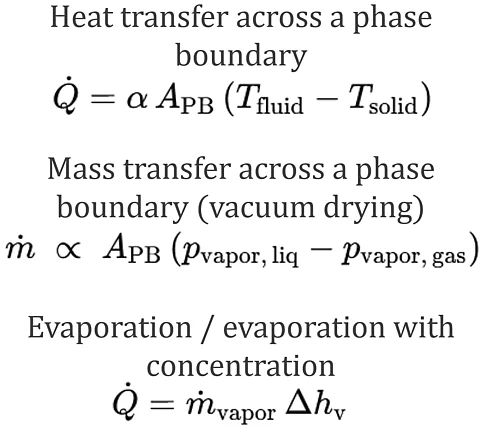
During temperature control, heat transfer occurs across the phase boundary between the particle surface and the heat transfer fluid. The heat flux can generally be described by:
Q̇ = α A_PB (T_fluid − T_solid)
- Q̇ is the heat transfer rate
- α is the heat transfer coefficient
- A_PB is the effective phase boundary area
- T_fluid is the fluid temperature
- T_solid is the solid temperature
Intensive mixing increases the effective phase boundary area and improves heat transfer. In vacuum drying, the phase boundary lies between the liquid moisture in or on the particle and the surrounding gas phase. The phase transition from liquid to vapour takes place at this interface. The mass flow across the phase boundary is determined by the vapour pressure gradient:
ṁ ∝ A_PG (p_vapor,liq − p_vapor,gas)
- ṁ is the time-dependent mass transfer rate
- ∝ is the proportionality symbol
- A_PG is the effective phase boundary area
- p_vapor,liq is the vapour pressure of the liquid at the particle surface
- p_vapor,gas is the vapour pressure in the gas phase
Lowering the ambient pressure reduces the boiling point and accelerates mass transfer. During evaporation and evaporation concentration, the liquid–gas interface forms the phase boundary. Heat and mass transfer occur simultaneously here. The heat supplied is converted into evaporation enthalpy at the phase boundary:
Q̇ = ṁ_vapor Δh_v
- Q̇ is the heat transfer rate
- ṁ_vapor is the mass flow rate of the evaporated substance
- Δh_v is the specific evaporation enthalpy
In bulk materials, this phase boundary may be located at the particle surface or within porous structures and may shift continuously during the process.
The location, size and accessibility of the phase boundary significantly influence the efficiency of temperature control, drying and evaporation processes. They determine the energy requirement and product quality. Through mixing, loosening or targeted agglomeration, the effective phase boundary can be specifically influenced.