

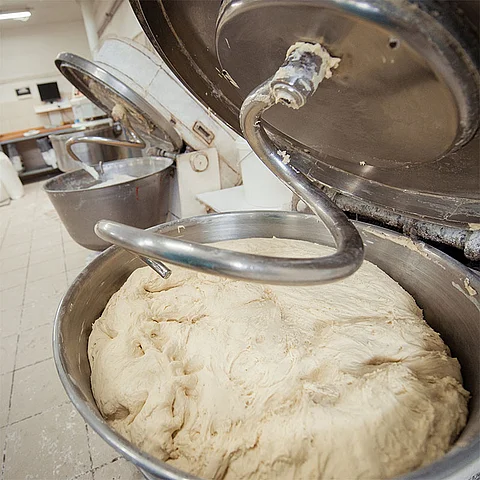
Paste-like
The term pasty describes a state of matter between solid and liquid. Pasty materials are malleable but do not flow freely. They behave like solids under low stress and only begin to flow once a certain mechanical stress is exceeded. Typical examples include pastes, slurries with a high solids concentration, or moist powder mixtures.
Rheologically, pasty systems are non-Newtonian fluids. A characteristic feature is the presence of a yield point. Only when the applied shear stress exceeds this yield point does irreversible deformation or flow commence.
This behaviour can be described using the Bingham model:
τ = τ0+ηp + γ˙
- τ is the shear stress
- τ0 is the yield stress
- ηp is the plastic viscosity
- γ˙ is the shear rate
For shear stresses τ < τ0, the material behaves in a solid-elastic manner. For τ ≥ τ0, it flows viscously. Many pasty materials also exhibit a shear-thinning behaviour, which can be described by the Herschel–Bulkley model.
- k is the consistency factor
- n < 1 is the flow index
Τ = τ0 + k · (γ˙)n
In the context of mixing and powder processing, a paste-like state is often created by adding small amounts of liquid to a powder. This results in the formation of liquid bridges between the particles. The resulting capillary forces lead to a cohesive, plastically deformable structure. The transition from dry powder to paste-like material marks a critical point in many processes, as flow behaviour, mixing mechanism and energy input change fundamentally. During vacuum mixing and drying, the consistency of the material changes in exactly the opposite way.

 Blog
Blog
 Related pages