
Particle structure
Particle structure describes the internal and external composition of individual particles as well as their spatial arrangement at different scales. It has a decisive influence on the mixing behaviour, mechanical stability and processability of powders.
At the micro- and submicroscale, it encompasses properties such as crystal structure, grain structure, porosity, defect density and the type of bonding. These characteristics, in turn, determine mechanical properties such as hardness, brittleness and fracture behaviour. They also influence interactions with liquids, gases and additives.
At the particle level, the particle structure describes the shape, surface roughness, internal porosity and density distribution of an individual particle. Porous or hollow particles exhibit different deformation and comminution behaviour than compact particles. The structure determines how particles absorb mechanical stresses during mixing, conveying or granulation.
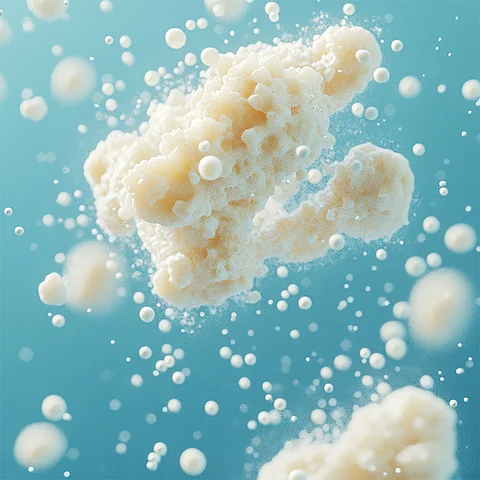
In the case of agglomerated particles, the particle structure encompasses the arrangement and bonding of several primary particles to form granules. The bonding mechanism, packing density, pore structure and fracture strength are decisive factors here. Agglomerates can be specifically produced or broken down, for example to adjust flowability, dust behaviour or reactivity.
In the mixing process, the particle structure acts both passively and actively. It determines the sensitivity to shear and impact stresses. At the same time, it can be specifically modified through mixing, for example by agglomeration, deagglomeration, coating or impregnation. In powder processing, the controlled adjustment of the particle structure is a key objective in order to achieve defined product properties.
 Blog
Blog