

Parallel flow heat transfer
Heat exchangers are used in numerous technical applications. Examples include condensers, rectification columns, heat pumps, cooling systems for drive motors, air conditioning systems, energy recovery systems and heating systems with thermal fluids. The aim is always to transfer thermal energy from a warmer medium to a colder medium. There is no mixing of the media.
The driving force behind heat transfer is a temperature difference. The transferred heat flow rate Q˙ can be generally described by
dQ/dt = dm/dt · cp · ΔT
Q˙ = m˙ · cp · ΔT
m˙ is the mass flow, cp is the specific heat capacity and ΔT is the temperature change of the medium. This formula applies to single-phase flow with constant cp.
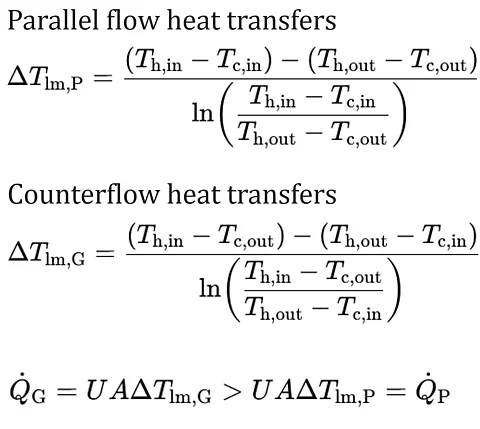
In parallel flow heat exchangers, both media flow in the same direction along the heat transfer surface. The highest temperature differences occur in the inlet area. Along the direction of flow, the temperatures of the two media quickly converge. The average driving temperature difference becomes smaller and smaller.
The logarithmic average temperature difference is often used for design purposes. The prerequisites are: no chemical reactions take place and no phase change occurs:
ΔTlm = (ΔT1−ΔT2) / ln (ΔT1 / ΔT2)
The opposite of a parallel flow heat exchanger is a counterflow heat exchanger. In a counterflow heat exchanger, the opposite flow direction results in a higher average driving temperature difference ΔTlm. With the same heat transfer area and heat transfer coefficient, this results in higher thermal efficiency compared to a parallel flow heat exchanger.
- ΔTlm is the logarithmic average temperature difference
- Th,in is the inlet temperature of the hot medium
- Th,out is the outlet temperature of the hot medium
- Tc,in is the inlet temperature of the cold medium
- Tc,out is the outlet temperature of the cold medium
- Q˙ is the heat flow rate
- Index G stands for counterflow
- Index P stands for parallel flow
- Index c stands for cold
- Index h stands for warm
- U is the total heat transfer coefficient
- A is the heat transfer area