
Inert gas
An inert gas is a gas that reacts hardly or not at all with other substances under the given process conditions. Typical inert gases are nitrogen, carbon dioxide, and noble gases such as argon, helium, or neon.
Inert gases are primarily used to dilute oxygen or other reactive gases in a system. This helps prevent oxidation, decomposition, or unwanted side reactions, reducing explosion risks. In process engineering, this process is referred to as inerting: reactors, mixers, or storage tanks are purged or pressurized with an inert gas to create a protective atmosphere.
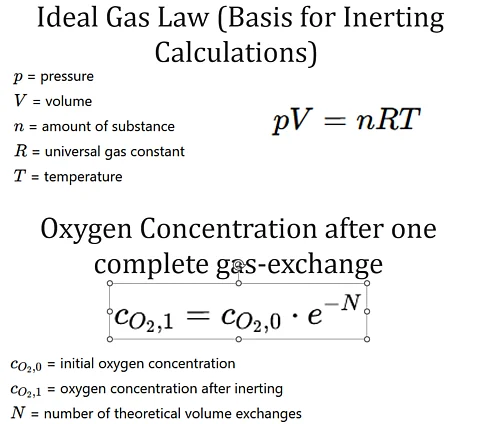
p = (n * R * T) / V
- - p – Pressure
- - V – Volume
- - n – Amount of gas
- - R – Universal gas constant
- - T – Absolute temperature
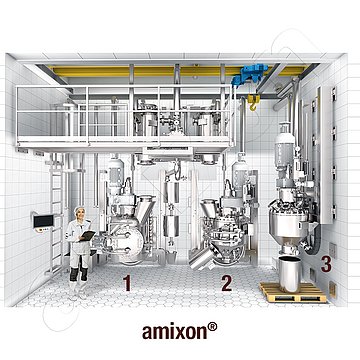
In amixon® industrial mixers, inert gases are used when the mixing material is flammable, sensitive to oxidation, or explosive. By vacuuming and then "blanketing" with inert gas or repeated purging, the oxygen content in the mixing chamber can be selectively reduced. This increases product shelf life, protects against quality losses, and contributes to process and plant safety.
This equation describes a complete pressure change (evacuating from p_high to p_low and refilling with inert gas):
c_(O2,1) = c_(O2,0) * (p_(low) / p_(high))
- - c_(O2,1) – Oxygen content after a complete gas exchange
- - c_(O2,0) – Initial oxygen content
- - p – Pressure
- - p_(high) – Pressure before evacuation (e.g., 1 bar abs)
- - p_(low) – Pressure after evacuation (e.g., 0.1 bar abs)
 Blog
Blog