

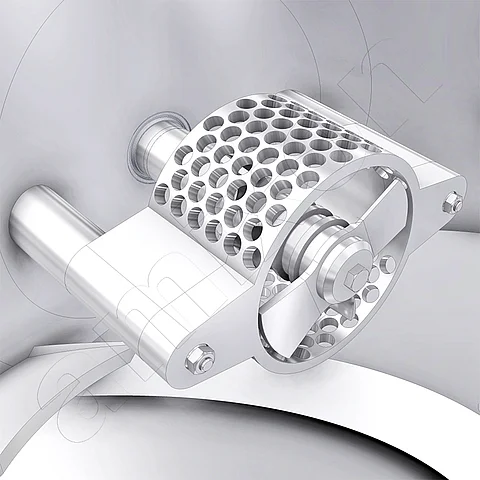
Impact crushing
Impact loading refers to a form of mechanical agitation in which solid particles are subjected to brief, impulsive forces. It is primarily used in comminution technology. The aim is the targeted breaking or crushing of particles.
Impact loading is characterised by very high local stresses and short exposure times. The kinetic energy applied is instantly converted into mechanical stress upon impact. This form of stress is particularly effective on hard and brittle solids with low elasticity. The particles break spontaneously along weak points or crystal boundaries. Typical applications are found in high-speed crushing machines. These include impact and impact mills and jaw crushers with rapid tool movements. Ball mills also operate on the principle of impact loading. In this case, comminution occurs through particle-particle and particle-wall collisions, usually without rotating tools.
Forms of stress involving predominantly abrasive, crushing or shearing force transmission must be distinguished from impact loading. These include tumbling mills, roller mills or peeling mills. Here, the forces act over longer periods and with lower impulse peaks. The comminution process is more continuous and less abrupt.
Impact crushing produces particles with sharp-edged, splinter-like morphology and low sphericity through brittle fracture. Abrasive-crushing mechanisms, on the other hand, lead to a progressive rounding of the particles. Comminution is a major field within mechanical process engineering. Effective comminution can also be achieved in mixers, although this usually involves deagglomeration.