

High-shear liquid homogenization
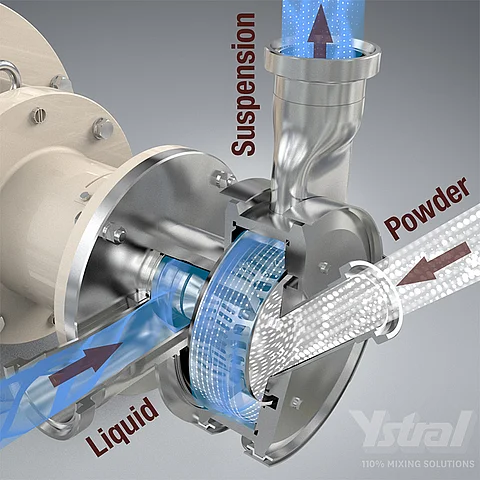
On the left, an image from the company Ystral. In high-shear liquid homogenization, mixing and dispersing processes are carried out in liquids. Very high shear gradients are generated to achieve a fine and as stable as possible distribution of droplets, solid particles, or gas bubbles in a continuous liquid phase. Typical applications include the production of emulsions and finely dispersed suspensions, as well as dissolving and deagglomerating poorly wettable powders in liquids.
For this purpose, high-speed rotors are used, for example rotor-stator systems, dispersing or cavitation tools. These move the liquid and the dispersed phase(s) against each other at high relative velocities. This creates strong shear forces and turbulence that break up larger droplets or agglomerates and create new interfaces. High-shear homogenization is used wherever conventional stirring is not sufficient to achieve the desired fineness or stability. Examples include creams, sauces, dispersions, lacquers, suspensions, or pharmaceutical formulations.
In contrast to simple stirrers, which primarily produce macroscopic mixing, high-shear technology aims at targeted reduction of particle or droplet size and a narrow size distribution. In practice, such units are implemented as batch or inline systems and are often combined with other process steps (heating/cooling, reaction, vacuum, gas addition). In system design, viscosity, solids content, the product’s sensitivity to shear, and the desired final particle spectrum are decisive.