

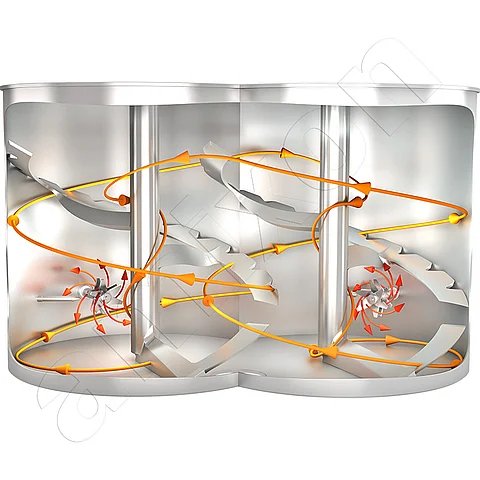
Flow effect
The flow-through effect describes the extent to which a fluid or a bulk solid flows through a process volume. The goal is for all areas of the apparatus to be reached by the flow. No stagnant zones or dead spaces should form.
In process engineering, a pronounced flow-through effect is a prerequisite for uniform mixing, homogeneous temperature distribution, and efficient mass transfer. The better the flow-through, the more uniform the concentration, moisture, and temperature in the product.
In powder mixers, the flow-through effect describes the movement and rearrangement of the particles throughout the entire mixing chamber. A three-dimensional, space-filling flow improves mixing quality and reduces segregation. At the same time, heat transfer and reaction kinetics are positively influenced.
The flow-through effect depends on apparatus geometry, mixing tool, rotational speed, and fill level. It can be specifically enhanced through design measures. A good flow-through effect contributes to process stability, energy efficiency, and product quality.