
Flocculation
Flocculation refers to processes in which very finely dispersed or colloidal solid particles in a liquid are combined into larger, loose aggregates ("flocs"). The aim is to aggregate the particles so that they can be separated more easily from the liquid by sedimentation, filtration, or flotation.
Typical applications of flocculation include water and wastewater treatment, drinking water treatment, process water purification, and various chemical and electroplating processes. For this purpose, flocculants (e.g., aluminum or iron(III) salts) and flocculation aids (polymers) are used. These destabilize the colloidal particles, neutralize their surface charges, and form bridges between the particles. The resulting flocs have a larger volume and higher settling velocities, which facilitates their removal.
Smoluchowski coagulation kinetics (perikinetic coagulation)
In perikinetic coagulation, which is caused by Brownian motion, the number concentration of particles decreases over time due to collisions and aggregation. Considering a dilute suspension in which two particles always merge to form one aggregate,
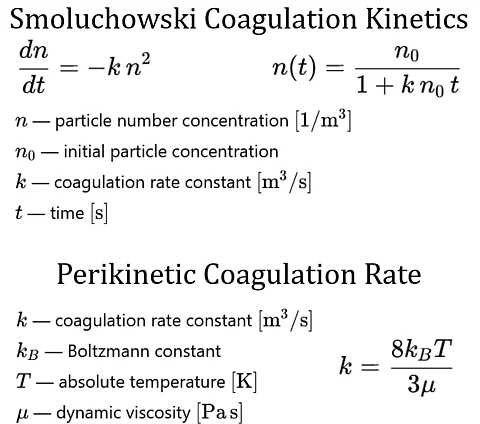
The temporal change of the particle number concentration n is then described by a simple second-order differential equation:
dn/dt = - k · n²
- n: particle number concentration [1/m³]
- k: coagulation rate constant [m³/s]
- t: time [s]
The right-hand side is proportional to n² because two particles "disappear" in each coagulation event, and the collision frequency is linked to the product of the concentrations of the colliding particles.
n(t) = n₀ / (1 + k · n₀ · t)
- n₀: initial particle concentration [1/m³]
- for t = 0, n(0) = n₀.
- As time t increases, n(t) decreases hyperbolically.
The larger k or n₀, the faster n(t) decreases.
Perikinetic coagulation constant (Brownian motion).
For spherical particles in a Newtonian fluid, the coagulation constant of perikinetic coagulation can be derived from Brownian motion and the Stokes–Einstein approach. The result is proportionality to temperature and an inverse dependence on viscosity.
k = (8 * k_B * T) / (3 * μ)
- k: coagulation rate constant [m³/s]
- k_B: Boltzmann constantcx
- T: absolute temperature [K]
- μ: dynamic viscosity of the fluid [Pa·s]
A higher temperature T leads to stronger Brownian motion, a higher collision rate, and a larger value of k. A higher viscosity μ leads to more strongly damped motion of the particles and thus to a lower collision rate and a smaller value of k.
Mechanistically, flocculation can be divided into two steps: first, coagulation (destabilization and initial agglomeration of very small particles), and then flocculation in the narrower sense (growth of particle aggregates through slow stirring and polymer addition). The efficiency depends on various factors, including pH, temperature, salinity, the type and concentration of colloids, and the dosage and type of flocculants.
 Blog
Blog