

Dust-explosive substances
“Dust-explosive” refers to the property of fine solid particles to form explosive dust-air mixtures. The prerequisite for this is a sufficiently fine particle size as well as a certain dust concentration in the air. An ignition source can ignite the mixture. This leads to rapid combustion with an increase in pressure.
Dust explosivity occurs with many organic and inorganic powders. Examples include sugar, flour, wood dust, plastics, metals, and battery materials. Crucial factors are the particle size, moisture, oxygen content, and turbulence.
In process engineering, dust-explosive substances are classified according to ATEX and EN standards. Important parameters are the Kst value, the maximum explosion pressure, and the minimum ignition energy. Possible protective measures include grounding, dust extraction, inerting, explosion pressure relief, and structural explosion protection.
For dust-explosive bulk materials, there are several central engineering formulas used in standards, expert reports, and equipment design. Many of these parameters originate from explosion tests in the 20-liter sphere apparatus or the 1-meter cubic vessel and are determined empirically.
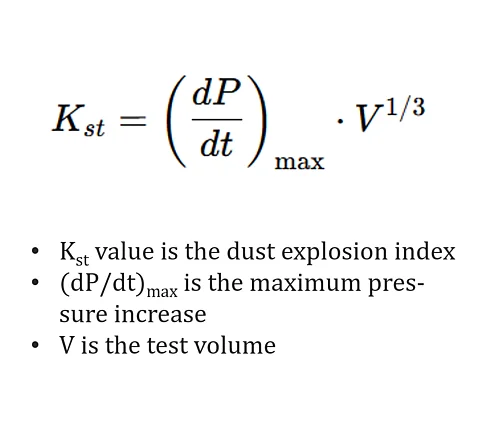
Kst = (dP/dt)max⋅ V1/3
- Kst value (dust explosion index)
- (dP/dt)max is the maximum rate of pressure rise
- V is the test volume
The Kst value determined in this way is normalized independently of volume and allows for the comparison of dusts. They are divided into dust explosion classes:
- St 0: Kst = 0 (non-explosive)
- St 1: 0–200 bar·m/s (e.g., flour, sugar)
- St 2: 200–300 bar·m/s
- St 3: > 300 bar·m/s (e.g., aluminum, magnesium)