

Degree of sheathing
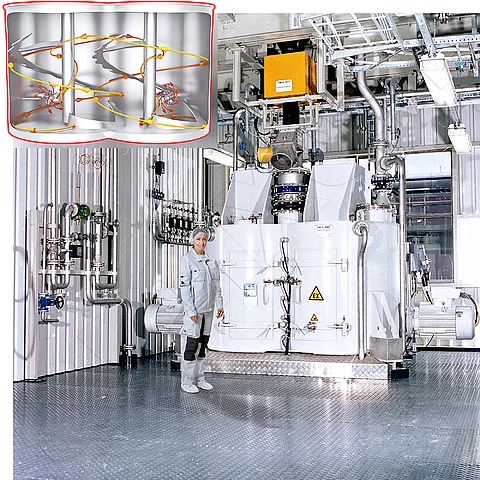
On the left you can see an amixon® apparatus for coating crop protection chemicals. The degree of coating is a measure of the portion of the particle surface that is covered by a shell layer. It describes how completely a core material has been coated. A high degree of coating means a closed and uniform coating layer.
The degree of coating can be described by the coated surface area:
θ = Acoated / Atotal
- θ is the degree of coating
- Acoated is the coated surface area
- Atotal the total particle surface area
In practice, the degree of coating is often described by the mass fraction of the coating layer:
wcoat = mcoat / mtotal
- wcoat is the mass fraction of the coating
- mcoat is the mass of the coating layer
- mtotal is the total mass of the coated particle
The effectiveness of the coating is described by the encapsulation efficiency:
ηenc = mcore,enc / mcore,total
- ηenc is the encapsulation efficiency,
- mcore,enc the effectively coated core mass
- mcore,total the total core mass
A high degree of coating improves storage stability, dosability, and the controlled release of active substances or propellants. A low degree of coating can lead to premature reaction, moisture uptake, or dust formation.
The degree of coating is specifically adjusted in the chemical, food, pharmaceutical, battery, and detergent industries.
 Blog
Blog

 Related pages