

Centrifugal acceleration
Centrifugal acceleration refers to the apparent, outward-directed acceleration that acts on a mass in a rotating frame of reference. It occurs when a body moves along a circular path. It is caused by the inertia of the mass, which opposes the continuous change in direction of its motion.
In process engineering, centrifugal acceleration is of great importance. It influences the behavior of particles, liquids, and gases in rotating equipment. Typical applications include mixers, centrifuges, cyclones, rotors, and agitators. With increasing rotational speed and growing distance from the axis of rotation, centrifugal acceleration increases, causing particles or liquid droplets to be driven outward. This effect can be used for separation, compaction, displacement, or targeted influence of flows.
In mixers and reactors, centrifugal acceleration affects particle motion and the mechanical loading of the equipment. It influences wall pressure, wear, shear forces, and energy input. Controlled design is necessary to ensure product quality, operational safety, and the service life of the plant.
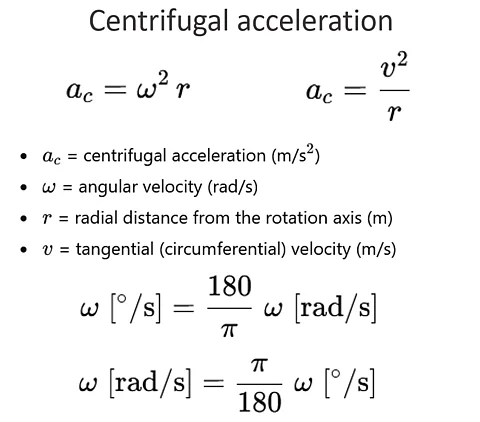
Centrifugal acceleration can be calculated with
ac = ω2⋅ r
- ac is the centrifugal acceleration in m/s²
- ω is the angular velocity in rad/s
- r is the distance from the axis of rotation in m
Alternatively, it can be described via the circumferential speed:
Ac = v2⋅ r
- V is the circumferential speed in m/s
- r is the distance from the axis of rotation in m