

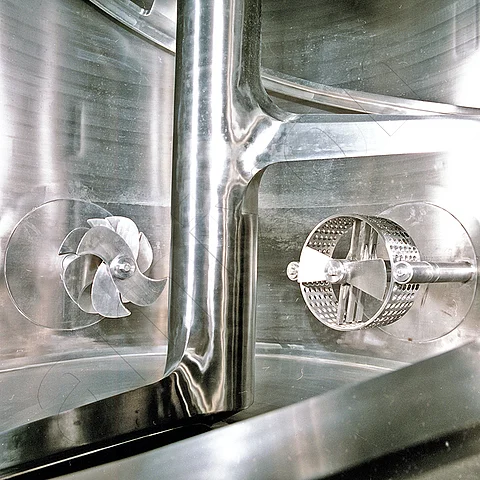
Aggressively deagglomerating
Mixing or comminution tools that generate strong shear, impact, and friction forces—and thereby reliably break up hard or highly cohesive agglomerates—are termed aggressively deagglomerating. The aim is to largely break particle clusters down into their primary particles—often at the expense of higher energy input, greater mechanical stress, and possibly some abrasion.
Typical approaches for a significant reduction of agglomerate size are:
- high peripheral speeds (e.g., cutting rotors, high‑shear blades, rotor‑stator systems)
- local energy densities that are significantly higher than those of a “gently mixing” system
A simple metric for the degree of deagglomeration can be formulated as follows:
D= 1 − m_(residual agglomerates) / m_(total agglomerates)
The closer D is to 1, the more “aggressive” or effective the deagglomeration process is.