

Active Pharmaceutical Ingredient Manufacturing: When Mixing Techniques Determine Quality
The article highlights how precise, reproducible mixing and tight temperature control are critical to API and finished-dose quality, given ultra-low active concentrations, diverse powder properties, and the risk of crystal damage and gradients. amixon® offers GMP/FDA/ATEX-compliant mixers, vacuum mixing dryers, and synthesis reactors featuring the low-shear SinConvex® tool, conical vessels for near-complete discharge, and large-area heat exchangers for uniform thermal profiles—addressing CDMO needs for flexible fill levels, validated cleaning, and containment. The company also provides process trials at its Technical Center and is extending capabilities to biotechnology with low-shear bioreactors/fermenters designed for variable viscosities and sensitive cell cultures.
amixon® develops and manufactures mixers, dryers, and vacuum synthesis reactors for the pharmaceutical industry—for manufacturers and contract manufacturers (CDMOs) of APIs, finished pharmaceutical products, and biotechnologically produced active ingredients. The systems comply with GMP, FDA, and ATEX requirements and are designed for cleanroom compatibility, full cleaning validation, and process reproducibility.
The pharmaceutical industry is one of the most demanding sectors in process and process engineering. For manufacturers and contract manufacturers of active pharmaceutical ingredients (APIs) and finished pharmaceutical products, one key question takes center stage: How can the highest product quality be reliably ensured while maintaining process reliability, reproducibility, and regulatory compliance?
The real challenge: precision on a small scale
Pharmaceutical solid-state processes are not mass-production processes in the traditional sense. Active ingredients are often present in minimal concentrations—for example, just a few micrograms in a 500-mg tablet. The mixing ratio can be as high as 1:1,000 or even 1:5,000. At the same time, the physical properties of the powders, granules, and excipients used vary considerably: particle size, bulk density, and flow behavior determine whether a process runs stably or not.
The situation becomes even more complex when it comes to API synthesis. Whether the process is chemical or biotechnological, the reactants must be uniformly distributed at all times. Forming crystals must not be sheared or damaged, as crystal properties directly determine drug release and, consequently, bioavailability. Temperature gradients in the reactor are a frequently underestimated quality risk in this context.
Pharmaceutical solid-state processes are not mass-production processes in the traditional sense. Active ingredients are often present in minimal concentrations—for example, just a few micrograms in a 500-mg tablet. The mixing ratio can be as high as 1:1,000 or even 1:5,000. At the same time, the physical properties of the powders, granules, and excipients used vary considerably: particle size, bulk density, and flow behavior determine whether a process runs stably or not.
The situation becomes even more complex when it comes to API synthesis. Whether the process is chemical or biotechnological, the reactants must be uniformly distributed at all times. Forming crystals must not be sheared or damaged, as crystal properties directly determine drug release and, consequently, bioavailability. Temperature gradients in the reactor are a frequently underestimated quality risk in this context.
Contract Manufacturers in Focus: Flexibility Is a Must
Contract pharmaceutical manufacturers (CDMOs) do not process a single product, but many—with changing formulations, different active ingredients, and varying batch sizes. Mixers, dryers, and reactors must therefore achieve consistent mixing quality at fill levels ranging from approximately 5% to 100% of the usable volume and be capable of being thoroughly cleaned in a manner that can be validated after each product change.
Closed, low-dust process chains (containment) are just as essential as comprehensive documentation in accordance with GMP requirements. Those who cannot provide robust cleaning validation risk not only product contamination but also regulatory consequences.
Contract pharmaceutical manufacturers (CDMOs) do not process a single product, but many—with changing formulations, different active ingredients, and varying batch sizes. Mixers, dryers, and reactors must therefore achieve consistent mixing quality at fill levels ranging from approximately 5% to 100% of the usable volume and be capable of being thoroughly cleaned in a manner that can be validated after each product change.
Closed, low-dust process chains (containment) are just as essential as comprehensive documentation in accordance with GMP requirements. Those who cannot provide robust cleaning validation risk not only product contamination but also regulatory consequences.
amixon® Solutions: Technology that grows with the task
amixon® develops and manufactures specialized mixing systems for the pharmaceutical industry in Paderborn. A key technical feature is the innovative SinConvex® mixing tool: It creates a three-dimensional redistribution of the material at very low speeds—without dead zones, gentle on sensitive structures, and efficient even with highly viscous materials or changing consistencies during the reaction.
For API synthesis, amixon® offers vacuum mixing dryers and synthesis reactors capable of mixing, drying, and temperature control simultaneously. Through large-surface-area heat exchanger walls—heated by steam, water, or thermal oil—temperatures in the reaction mixture can be precisely controlled without gradients. This is crucial for uniform nucleation during crystallization and thus for the reproducibility of active ingredient quality.
The conical vessel geometry (AM, AMT, KS series) in combination with the SinConvex® tool enables nearly complete residual discharge. This reduces product losses, simplifies cleaning, and significantly lowers the effort required for validation.
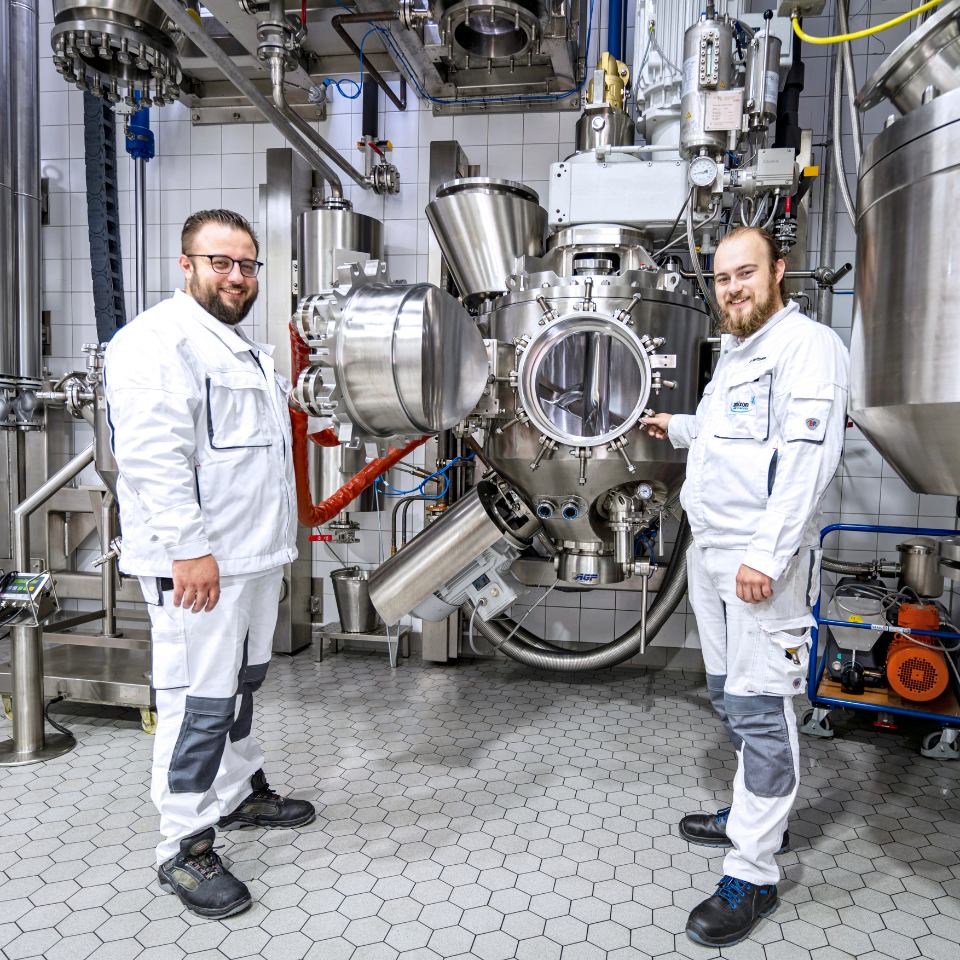
Thanks to its conical shape, the amixon® AMT vacuum mixing dryer ensures that the contents are almost completely emptied.
amixon® develops and manufactures specialized mixing systems for the pharmaceutical industry in Paderborn. A key technical feature is the innovative SinConvex® mixing tool: It creates a three-dimensional redistribution of the material at very low speeds—without dead zones, gentle on sensitive structures, and efficient even with highly viscous materials or changing consistencies during the reaction.
For API synthesis, amixon® offers vacuum mixing dryers and synthesis reactors capable of mixing, drying, and temperature control simultaneously. Through large-surface-area heat exchanger walls—heated by steam, water, or thermal oil—temperatures in the reaction mixture can be precisely controlled without gradients. This is crucial for uniform nucleation during crystallization and thus for the reproducibility of active ingredient quality.
The conical vessel geometry (AM, AMT, KS series) in combination with the SinConvex® tool enables nearly complete residual discharge. This reduces product losses, simplifies cleaning, and significantly lowers the effort required for validation.
Thanks to its conical shape, the amixon® AMT vacuum mixing dryer ensures that the contents are almost completely emptied.
Built-in regulatory compliance
amixon® supports its customers in meeting key industry standards: GMP compliance, ATEX, FDA approval, and the full qualification chain (DQ / IQ / OQ / PQ). For pharmaceutical companies, this regulatory compliance is not an option—it is a prerequisite for market access.
Particularly valuable for manufacturers and contract manufacturers is the opportunity to test processes at the amixon® Technical Center in Paderborn using original ingredients. Mixing behavior, liquid addition, temperature control, vacuum drying, and discharge strategies can be examined under real-world conditions and specifically optimized—before an investment decision is made.
amixon® supports its customers in meeting key industry standards: GMP compliance, ATEX, FDA approval, and the full qualification chain (DQ / IQ / OQ / PQ). For pharmaceutical companies, this regulatory compliance is not an option—it is a prerequisite for market access.
Particularly valuable for manufacturers and contract manufacturers is the opportunity to test processes at the amixon® Technical Center in Paderborn using original ingredients. Mixing behavior, liquid addition, temperature control, vacuum drying, and discharge strategies can be examined under real-world conditions and specifically optimized—before an investment decision is made.
Outlook: Biotechnology and Scalability
The share of biotechnologically produced APIs is growing—insulin, monoclonal antibodies, growth hormones, and vaccines are increasingly being produced using this method. Mild reaction conditions, biodegradable enzymes, and less hazardous byproducts make these processes attractive. The amixon® bioreactor / fermenter is also designed for variable viscosities and protects sensitive cell cultures from shear stress and pressure.
The share of biotechnologically produced APIs is growing—insulin, monoclonal antibodies, growth hormones, and vaccines are increasingly being produced using this method. Mild reaction conditions, biodegradable enzymes, and less hazardous byproducts make these processes attractive. The amixon® bioreactor / fermenter is also designed for variable viscosities and protects sensitive cell cultures from shear stress and pressure.
Frequently Asked Questions (FAQ)
What is a GMP-compliant mixer for the pharmaceutical industry?
A GMP-compliant mixer meets the requirements of Good Manufacturing Practice: dead-space-free design, complete cleanability, and comprehensive documentation and validability of all process steps. amixon® mixers in the AM, AMT, and KS series are specifically designed to meet these requirements.
Which mixers are suitable for the production of active pharmaceutical ingredients (APIs)?
Vacuum mixing-drying synthesis reactors, which combine mixing, drying, and temperature control in a closed system, are suitable for API synthesis. amixon® offers such systems with a large-surface-area heat exchanger wall and the gentle SinConvex® mixing tool.
How does a vacuum mixing dryer work in pharmaceutical production?
A vacuum mixing dryer removes moisture from the product under vacuum, while the mixing tool ensures uniform heat distribution and homogeneous mixing quality. This is particularly crucial during the crystallization and drying of sensitive active ingredients.
Why is the mixing ratio so critical in the pharmaceutical industry?
Active ingredients in tablets or capsules are often present in concentrations ranging from 1:1,000 to 1:5,000. Uneven distribution leads to underdosed or overdosed units—a direct safety risk for patients and a regulatory issue.
What is a CDMO and what mixing requirements does it have?
A CDMO (Contract Development and Manufacturing Organization) is a pharmaceutical contract manufacturer that produces for various clients. CDMOs require mixers that operate reliably with variable batch sizes (5–100% fill level), can be quickly retooled, and allow for validated cleaning.
What certifications do mixers for the pharmaceutical industry require?
Relevant certifications and standards include GMP (Good Manufacturing Practice), FDA compliance (for the U.S. market), ATEX (explosion protection), and the qualification documentation DQ, IQ, OQ, and PQ. amixon® supports customers in the complete qualification of their systems.
Learn more about the benefits of amixon® mixers, dryers, and reactors for pharmaceutical applications in our fact sheet!
What is a GMP-compliant mixer for the pharmaceutical industry?
A GMP-compliant mixer meets the requirements of Good Manufacturing Practice: dead-space-free design, complete cleanability, and comprehensive documentation and validability of all process steps. amixon® mixers in the AM, AMT, and KS series are specifically designed to meet these requirements.
Which mixers are suitable for the production of active pharmaceutical ingredients (APIs)?
Vacuum mixing-drying synthesis reactors, which combine mixing, drying, and temperature control in a closed system, are suitable for API synthesis. amixon® offers such systems with a large-surface-area heat exchanger wall and the gentle SinConvex® mixing tool.
How does a vacuum mixing dryer work in pharmaceutical production?
A vacuum mixing dryer removes moisture from the product under vacuum, while the mixing tool ensures uniform heat distribution and homogeneous mixing quality. This is particularly crucial during the crystallization and drying of sensitive active ingredients.
Why is the mixing ratio so critical in the pharmaceutical industry?
Active ingredients in tablets or capsules are often present in concentrations ranging from 1:1,000 to 1:5,000. Uneven distribution leads to underdosed or overdosed units—a direct safety risk for patients and a regulatory issue.
What is a CDMO and what mixing requirements does it have?
A CDMO (Contract Development and Manufacturing Organization) is a pharmaceutical contract manufacturer that produces for various clients. CDMOs require mixers that operate reliably with variable batch sizes (5–100% fill level), can be quickly retooled, and allow for validated cleaning.
What certifications do mixers for the pharmaceutical industry require?
Relevant certifications and standards include GMP (Good Manufacturing Practice), FDA compliance (for the U.S. market), ATEX (explosion protection), and the qualification documentation DQ, IQ, OQ, and PQ. amixon® supports customers in the complete qualification of their systems.
Learn more about the benefits of amixon® mixers, dryers, and reactors for pharmaceutical applications in our fact sheet!
 Related News
© Copyright by amixon GmbH