
Wetting process
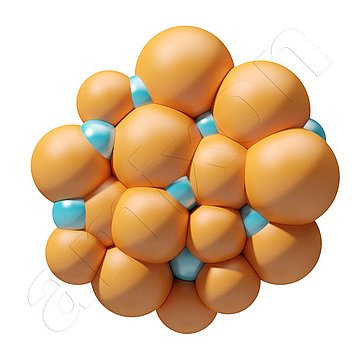
In process engineering, wetting refers to the process by which a liquid coats solid surfaces. Air trapped between the particles is displaced and replaced by liquid. The aim is to achieve uniform coverage of all particle surfaces. Wettability depends on the ratio of surface energies between the solid, the liquid and the gas phase. It is described by the contact angle:
γ_SG = γ_SL + γ_LG · cos(θ)
The following applies: θ < 90° → good wetting; θ > 90° → poor wetting.
- γ_SG = solid–gas interfacial tension
- γ_SL = solid–liquid interfacial tension
- γ_LG = liquid–gas interfacial tension
- θ = contact angle
Types of wetting:
a) Suspension wetting (incorporating powders into liquids). A finely dispersed powder is distributed in a liquid medium to produce a homogeneous suspension or solution. All entrapped air must be removed and agglomerates broken down into primary particles. The result is a pumpable dispersion or solution. High-shear mixing systems are used for this purpose, such as rotor-stator systems, cutting rotors or systems with vacuum feed. These devices generate high energy densities to ensure uniform flow around the particles and stabilise them.
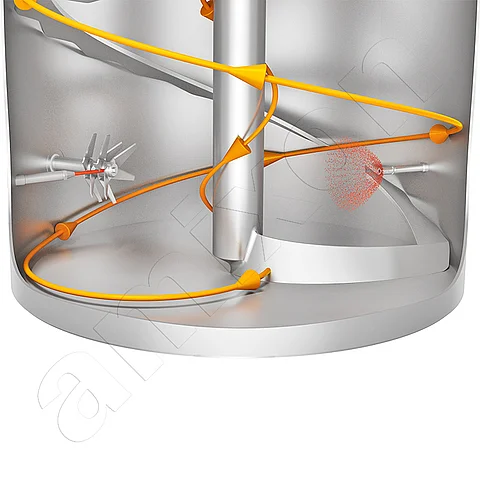
b) Suspension wetting (application of liquid to powder mixtures). A bulk material is treated with a defined quantity of liquid. The aim is to produce a homogeneous, free-flowing mixture in which the particle surfaces are uniformly wetted in the correct proportion. Agglomerates are either retained or specifically deagglomerated. Precision powder mixers are used, which mix and wet the material gently or with intensive dispersion, depending on the task. In spray wetting, the liquid is finely atomised via nozzles. Droplet size, droplet distribution, nozzle orientation and position within the mixing chamber determine the homogeneity and wetting rate. Fine droplets increase the likelihood of contact and improve particle coverage.
Types of processes: Wetting processes may include:
- Discontinuous batch processes, e.g. spray wetting in a batch mixer.
- Continuous inline processes, e.g. powder coating systems with a rotor-stator system and vacuum feed.
In amixon® powder mixers, the liquid is finely atomised below the level of the bulk material. It enters directly into the intense particle flow, where it is distributed evenly. This reduces processing time and improves homogeneity. The processes can be operated either extremely gently or with a high degree of deagglomeration. Demonstrations and trials take place at the amixon® technical centre.
 Blog
Blog