

vertical force
The vertical force is the component of force acting perpendicular to the horizontal plane. In process engineering, it is often caused by the weight of bulk materials, components or fluids. The vertical force acts in the direction of gravity and is often transmitted as a normal force to surfaces or components.
Vertical forces influence friction, compaction and mechanical stress. In bulk material handling equipment, they determine the contact pressure between particles and between the product and the container wall. As a result, they affect flow behaviour, discharge and mixing processes.
In mixers and reactors, vertical forces act in conjunction with horizontal and tangential forces. They contribute to the redistribution of particles and influence the mechanical stress on the product. Controlling the vertical force is important to prevent over-compaction or damage to the material.
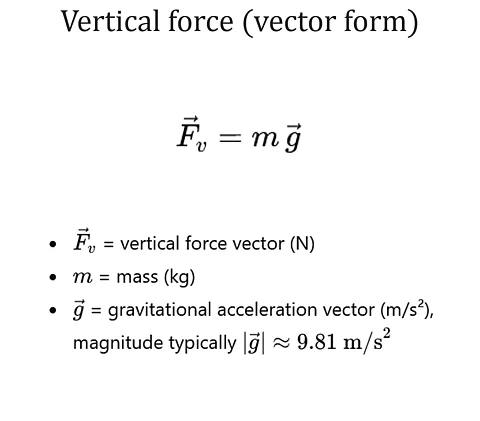
The vertical force can be described simply as:
Fv = m * g
- Fv is the vertical force (N)
- m is the mass (kg)
- g is the acceleration due to gravity (≈ 9.81 m/s²)
Vertical forces are a key factor in the design of vessels, support structures, bearings, mixing tools and discharge devices.