

Van der Waals forces
Van der Waals forces are weak physical attractive forces between neutral atoms, molecules, or particles. They arise from temporary or permanent electrical dipoles. The forces act over short distances and decrease sharply with increasing distance.
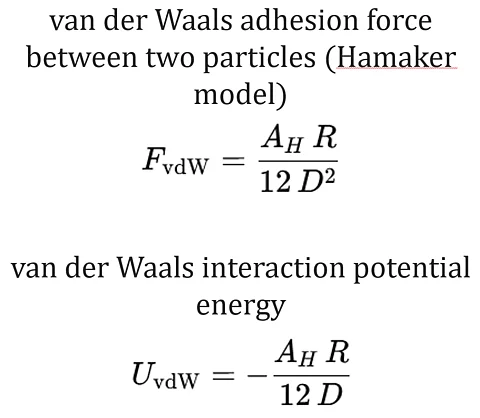
Van der Waals adhesion force between two spherical particles (Hamaker approach):
F_vdW = (A_H * R) / (12 * D^2)
- F_vdW is the van der Waals force between two particles (N)
- A_H is the Hamaker constant of the material (J)
- R is the effective particle radius (m)
- D is the distance between the particle surfaces (m)
In powder and bulk solids technology, van der Waals forces are particularly important for fine and ultrafine particles. As particle size decreases, they become much more significant relative to gravity. They cause agglomeration, cohesion, and adhesion of fine particles to surfaces.
Van der Waals potential energy between particles:
U_vdW = - (A_H * R) / (12 * D)
- U_vdW is the van der Waals potential energy (J)
- A_H is the Hamaker constant (J)
- R is the effective particle radius (m)
- D is the distance between the surfaces (m)
Van der Waals forces also influence flowability, dustiness, mixing behavior, and segregation. They are an essential mechanism in dry agglomeration, dry prilling, and dust separation in filters.
In process engineering, van der Waals forces are purposefully utilized or reduced, for example through surface modification, moisture addition, granulation, or the input of mechanical energy.