

turbulence region
The turbulent regime is a flow state with unstable, vortex-rich motion. Velocity and pressure fluctuate locally and over time. Vortices of different sizes form.
The opposite of turbulent flow is laminar flow. This difference can be illustrated using pipe flow. If a liquid flows slowly through a pipe, the flow is laminar. If it flows quickly, the flow becomes turbulent. This transition is described by the Reynolds number. In pipe flows, a turbulent regime typically applies from about Re > 4000.
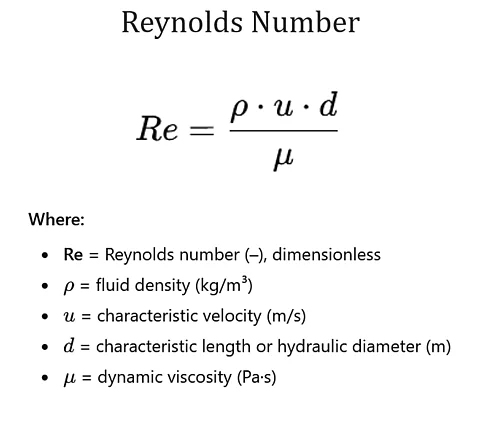
The Reynolds number describes the ratio of inertial forces to viscous forces in a flow. Low Reynolds numbers indicate laminar flow. High Reynolds numbers indicate turbulent flow.
Re = ρ ⋅ u⋅ d / μ
- Re is the Reynolds number (–), dimensionless
- ρ is the density of the fluid
- u is the characteristic velocity
- d is the characteristic length or the hydraulic diameter
- μ is the dynamic viscosity
This concept can be conceptually applied to the flow in powder mixers. A high-speed rotation of the cutting rotor leads to strong swirling of the powder particles and thus to a turbulence-like state. The slow, low-dust shear flow resulting from the mixing screw, on the other hand, corresponds to an orderly, laminar transport mechanism.
In process engineering, turbulence is deliberately used to intensify mixing, heat transfer, and mass transport. At the same time, an orderly shear flow can be advantageous to minimize dust generation and particle breakage.