

to ferment
Fermentation refers to biochemical conversion processes in which microorganisms or enzymes break down organic substrates, forming metabolic products such as acids, alcohols, gases or flavourings. Fermentation is used in the food, pharmaceutical and biotechnology industries to preserve and refine products or to produce specific active ingredients and flavourings. Typical fermentation processes include the production of yoghurt, sauerkraut, beer, wine, vinegar, enzymes and pharmaceutical active ingredients.
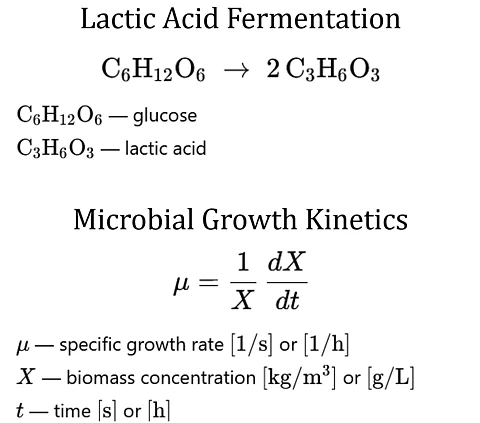
In terms of substances, microorganisms convert energy-rich substrates (e.g. sugar) under mostly anaerobic or microaerobic conditions. A greatly simplified fermentation reaction (lactic acid fermentation) can be represented as follows, for example:
C₆H₁₂O₆ → 2 · C₃H₆O₃
Glucose is converted into lactic acid, releasing energy in the form of ATP in the microorganism. In alcoholic fermentation, a common molecular formula is:
C₆H₁₂O₆ → 2 · C₂H₅OH + 2 · CO₂
Here, glucose is converted into ethanol and carbon dioxide.
Technically, fermentation usually takes place in bioreactors or fermentation tanks. Important process variables are temperature, pH value, oxygen supply (aerated or un-aerated or slightly aerated), stirring intensity, nutrient composition and duration. The kinetics of microorganism growth are often described using the following simplified relationship:
μ = (1/X) · (dX/dt)
- μ: specific growth rate
- X: Biomass concentration
- t: Time Time
Product formation can be viewed using similar balance sheet approaches, for example:
r_P = (dP/dt)
- r_P: Formation rate of the product
- P: Product concentration
In mixers and process vessels, homogeneous distribution of microorganisms, substrate and any added gases is crucial for fermentation processes. Effective stirring ensures that the temperature and pH value remain uniform, nutrients are well distributed and the reaction conditions are as similar as possible at all points in the fermenter. This supports reproducible product qualities, a defined aroma profile and consistent yields.
Depending on the process objective, fermentation can be carried out as a batch, fed-batch or continuous process. In batch fermentation, a batch is prepared and processed to the desired degree of conversion. In the fed-batch process, the substrate supply can be specifically controlled during fermentation to avoid undesirable side reactions (e.g. due to excessive sugar concentrations). Amixon® devices are ideal for fermentation processes. This is explained in the blog post "Fermentation in the amixon fermenter reactor".