Time hardening
Time consolidation describes the increase in the internal strength of a material over the course of storage at rest. This effect can occur even without additional external mechanical loading, for example solely due to self-weight or environmental conditions. The cause is time-dependent physical or chemical structural changes in the material.
In process engineering, time consolidation is particularly important for fine-grained powders and bulk solids, pasty and viscoplastic materials. Examples include moisture-sensitive powders, freshly milled sugar, doughs, pasty mixtures, as well as products with starch, cellulose derivatives, or thickeners. Bulk solids can compact in a silo or IBC during storage, form bridges or "cake," and thereby lose their flowability.
The causes of time consolidation are diverse. These include the rearrangement of particles and molecules, contact strengthening at grain boundaries, the formation of liquid bridges, crystallization processes, or physical crosslinking mechanisms. Time consolidation is often accompanied by an increase in apparent viscosity, a rising yield stress, or a higher shear resistance.
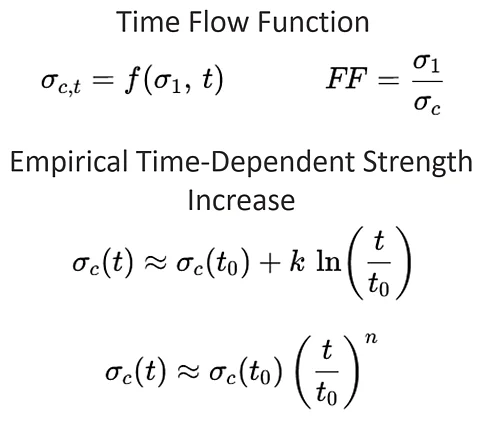
σc= f(σ1)
- σ1 is the major consolidation stress. That is the highest normal stress under which the bulk solid was previously loaded
- σc is the uniaxial compressive strength. That is the maximum compressive stress that a material can withstand when loaded in only one direction before it "breaks"
- ffc is the flow function index
A commonly used characteristic quantity is the flow function index / Flowability Index ffc. The greater the ffc, the better the flowability
ffc = σ1 / σc
In practice, an empirical description can be used as a "fit model" to determine the increase in strength σc(t).
σc(t) ≈ σc(t0) · (t/t0)n
- t0: is the initial time at which the strength σc(t0) is known, for example after 1 hour
- n is a dimensionless exponent that indicates how strongly the strength increases with time; it is fitted from measurement data and is material- and condition-specific
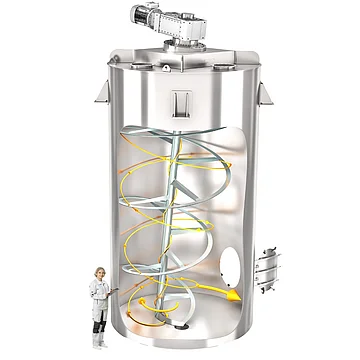
Time consolidation affects mixing, conveying, storage, and dosing. Products that consolidate after standstill require higher torques, more powerful drives, or special discharge aids when restarting. In mixers, reactors, and storage vessels, this effect must be taken into account in design, process operation, and in the choice of discharge devices. Through slow, dead-space-free movement, time consolidation can be completely avoided. An excellent technical solution for this is the Gyraton® silo mixer from amixon®.