

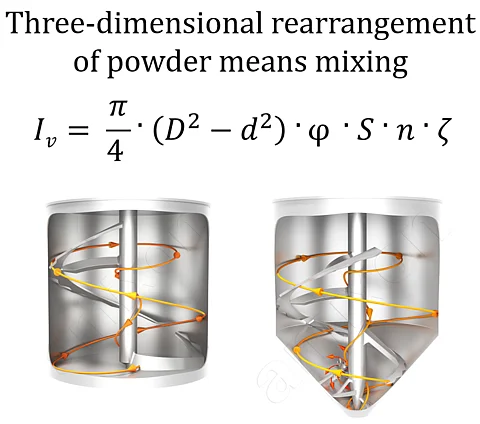
Three-dimensional rearrangement
In three-dimensional rearrangement, particles move in all three spatial directions. The particles are transported axially, radially, and tangentially. The entire bulk material volume is repeatedly traversed.
Vertical helical mixers produce a particularly effective rearrangement by loosening the mixing materials.
𝐼𝑣 = 𝜋/4 · (𝐷2−𝑑2) ·φ ·𝑆 ·𝑛 ·𝜁
- 𝐼𝑣: conveying capacity of a vertical mixing helix
- D/d: outer diameter/inner diameter of the helix
- φ is the degree of fill
- S is the pitch of the helix
- N is the rotational frequency
- 𝜁 is the velocity coefficient
This process leads to complete mixing. Each particle regularly changes its neighbors. Dead zones and segregation are reduced. The residence time distribution is homogenized.
In convective bulk material mixers, three-dimensional rearrangement is deliberately generated. Mixing helices, conveying elements, and gravity circulation create closed flow loops. The product is conveyed upward along the vessel wall and falls back down in the central area.
This three-dimensional rearrangement is typical of cone mixers, hollow-sphere mixers, twin-shaft mixers, and other slowly rotating bulk material mixers with a vertical mixing shaft. It enables short mixing times with low turbulence intensity and dust generation.