
Thermal drying
In thermal drying, moisture is removed from solids, suspensions or granules by heating. The aim is to reduce the moisture content to a specified level.
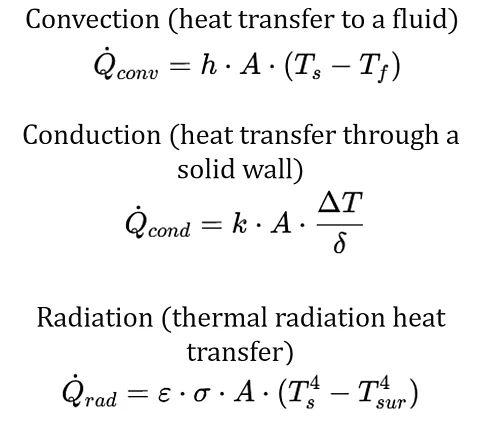
Drying can be carried out by Convection, Conduction or radiation this is achieved. Hot air, steam, inert gas or heated surfaces are often used. The evaporated moisture is carried away by a gas stream.
Thermal drying is used in the chemical, food, pharmaceutical, battery and plastics industries. It affects product quality, shelf life, reactivity and flow behaviour. The design process takes into account temperature, residence time, moisture content and mass transfer.
Convective heat transfer:
Q̇_conv = h · A · (T_s − T_f)
- Q˙conv is the convective heat transfer rate
- h is the convective heat transfer coefficient
- A = Heat transfer area
- Ts = Surface temperature (K or °C)
- Tf = fluid temperature (K or °C)
Heat conduction; Fourier's law:
Q̇_cond = k · A · (ΔT/δ)
- Q˙cond = heat transfer rate
- k is the thermal conductivity of the material
- A is the cross-sectional area
- ΔT is the temperature difference on either side of the wall
Heat flux density:
q = Q̇ / A
- δ = wall thickness
- q = heat flux
Radiative heat transfer; Stefan–Boltzmann law:
Q̇_rad =ε ·σ · A · (T_s^4 - T_sur^4)
- Q˙rad is the rate of radiant heat transfer
- ε is the emissivity of the surface
- σ is the Stefan–Boltzmann constant: σ = 5.67×10^(−8) W/m²K⁴
- A is the radiating surface
- T is the surface temperature
- Tsur is the ambient temperature
 FAQ - Thermal drying
 Blog
Blog