

Thermal conductivity
Thermal conductivity is a material-dependent property. It indicates how well a material conducts heat. Materials with high thermal conductivity transfer heat quickly. Materials with low thermal conductivity, on the other hand, act as thermal insulators.
In process engineering, thermal conductivity influences heat transfer in solids, bulk materials, liquids and gases. It is crucial for heating and cooling times, temperature distribution and energy efficiency.
However, in the case of bulk materials, the effective thermal conductivity does not depend solely on the material itself. Porosity, bulk density, contact surfaces and entrapped gases also play a role. Bulk materials in motion often exhibit higher effective heat transfer than those at rest.
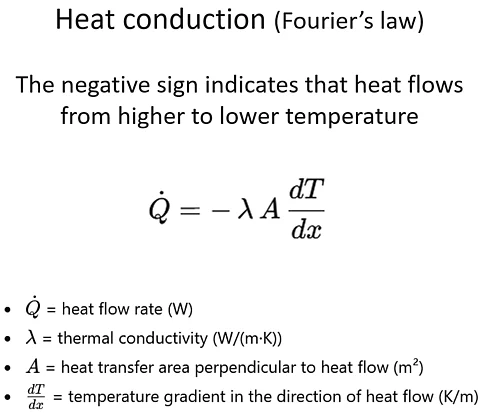
Thermal conductivity is particularly important in the design of mixers, reactors, dryers and heat-transfer equipment. It determines how quickly heat is transferred from the heating or cooling medium to the product. Heat flow by conduction can be described as follows:
Qdot = -λ * A * (dT / dx)
- Qdot is the heat flux (W)
- λ is the thermal conductivity (W/(m·K))
- A is the heat transfer area (m²)
- dT/dx is the temperature gradient (K/m)
The negative sign indicates that heat always flows towards the lower temperature.