

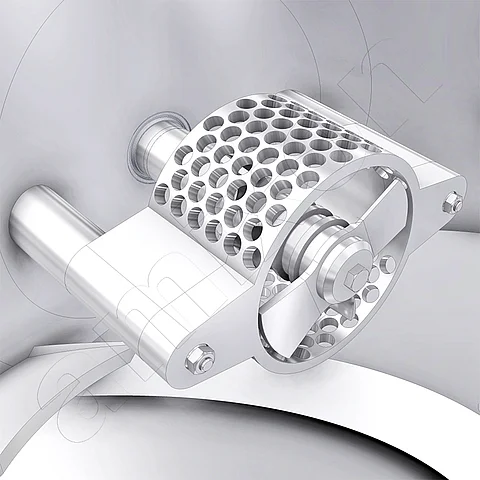
Rotor-stator machines
Rotor-stator machines are devices used to subject material systems to intense mechanical shearing. They consist of a rotating component, the rotor, and a stationary component, the stator. A narrow gap exists between the rotor and the stator. The rotor rotates at high peripheral speed. This creates very high shear gradients in the gap area. Solid particles, liquids, suspensions or paste-like systems are thereby strongly accelerated. The product is drawn into the rotor-stator gap. There it is subjected to shearing, stretching and turbulence. It is then ejected again. Rotor-stator machines are used for dispersion. They are also used for emulsification.
Furthermore, rotor-stator machines are used for the comminution of agglomerates. The mechanical energy input is very high in this process. It occurs locally and for a short duration. The resulting stresses are significantly higher than with slow-running mixers.
In process engineering, rotor-stator machines are primarily used in liquid or liquid-solid systems. Typical applications include emulsions, suspensions and slurries.
For dry powders, however, they are only of limited suitability. The high shear forces can lead to undesirable heating. Furthermore, fine dust formation and material wear may occur. A key design parameter is the gap between the rotor and stator. Smaller gaps increase the shear intensity. However, they also increase the energy input. The process effect depends on the speed, the geometry and the throughput.