
Residence time spectrum
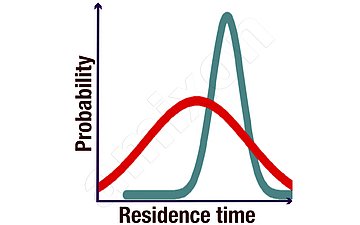
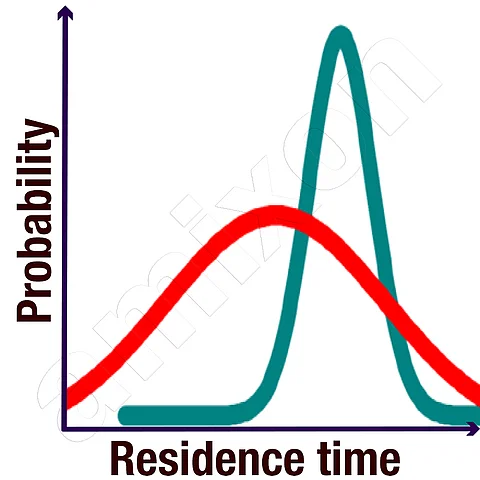
The residence time spectrum describes the statistical distribution of the residence times of particles or fluid volumes in a continuously operated apparatus. It shows how long individual product fractions remain in the system between entry and exit. In real processes, the residence time is not identical for all particles but distributed over a period of time.
Depending on the type of continuous mixer and the nature of the task, apparatus with a very short or longer mean residence time are used. Both variants are technically sensible and fulfill different process engineering tasks. Continuous mixers with a short residence time are suitable for rapid homogenization, gentle handling, or high throughputs. Continuous mixers with a longer residence time are used when reactions, drying, temperature control, or material transformations require time.
The two types are not mutually interchangeable. The respective residence time spectrum must match the process task. What is decisive is not whether the residence time spectrum is short or long, but whether it is reproducible, stable, and suitable for the desired process effect.
The residence time spectrum is often described by a distribution function:
E(t)= dF(t) / dt
- E(t) is the residence time density function
- F(t) is the cumulative residence time distribution
- t is time
The mean residence time results from:
t_m = Integral ( t * E(t) dt )
A correctly designed continuous mixer or reactor is characterized by the fact that its residence time spectrum is specifically adapted to the respective process task.

 Blog
Blog