

Precision mixers
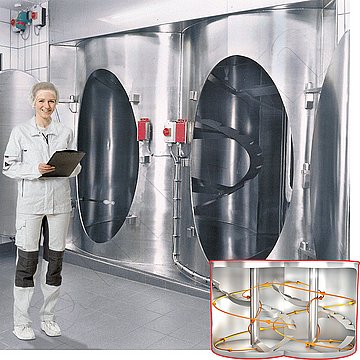
Precision mixers are mixing systems that achieve a particularly high and reproducible mixing quality. Although the term is not a standardised technical term, it is colloquially used for systems that bring powder mixtures to the practically achievable limit state of homogeneity.
In powder mixtures, this limit corresponds to an idealised, statistical random mixture. It represents the maximum achievable mixing quality; no further technical improvement is then possible. A precision mixer is therefore a mixing system that reliably achieves this state.
The progress of homogenisation is time-dependent and asymptotic. It can be described mathematically by:
Vx(t) = V0 · e(−k·t) + V∞
- Vx(t) is the coefficient of variation of the mixture at time t
- V0 is the initial value of the coefficient of variation at t = 0, i.e. the state prior to or at the start of the mixing process
- t is the mixing time
- V0 is the mixing quality state prior to the mixing process
- k is a system-specific mixing constant. It depends on the mixing system and the materials being mixed.
- V∞ is the asymptotic limit of the mixing quality. This limit corresponds to the ideal random distribution.
A lower coefficient of variation indicates greater homogeneity. However, V∞ should not be equated with ‘perfectly homogeneous’, but rather understood as the residual value of the random dispersion. An ideal distribution would only be achieved if every single particle were arranged in the correct position within a three-dimensional matrix, exactly in accordance with the mixture composition. However, this is merely a theoretical concept.
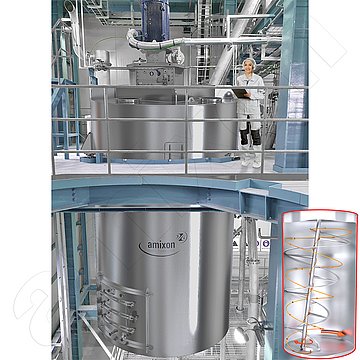
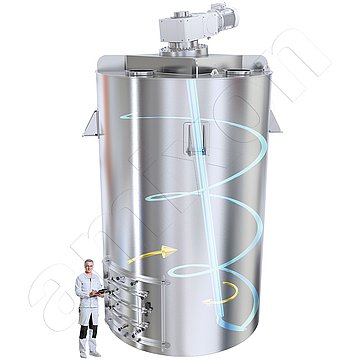
The mixing quality achieved can be analytically demonstrated via the coefficient of variation of the sample composition. Values significantly below 5% are regarded as very high mixing quality in process engineering. In the amixon® blog post “Mixing silo achieves optimum mixing quality”, the mixing quality of a Gyraton® mixing silo is examined as an example. The measured coefficients of variation are in fact well below 5%.
 Blog
Blog