Powder ring layer
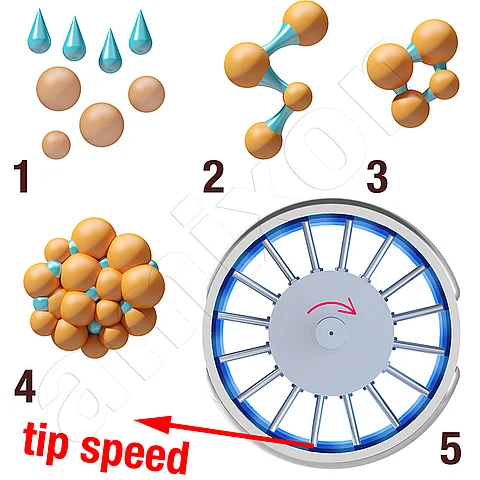
A powder ring layer forms when a powder is strongly accelerated by a centrally mounted mixing tool in a cylindrical mixing chamber. The mixing tool rotates at high peripheral speed. The powder particles are forced into a quasi-circular path by inertia.
The particles experience centrifugal acceleration. This is approximately
az = ω2·r
- where ω is the angular velocity
- and r is half the rotational diameter
The resulting centrifugal force F acting on a particle of mass m is
Fz = m·ω2·r
This presses the powder against the inner wall of the mixing cylinder.
In a steady state, a ring-shaped, densely packed region forms. This is referred to as a powder ring layer. In this layer, there is equilibrium between centrifugal force, gravitational force and wall friction.
The contact forces between the particles and the wall lead to high shear stress. The wall friction force increases with the normal force, which is determined by the centrifugal force. Simplified
FR = μ·FN
- μ is the coefficient of friction
- FN is the normal force
The greater ω and r, the higher the normal forces and thus the shear stress in the ring layer. The constant interplay of acceleration by the mixing tool and deceleration at the wall causes intense relative movement of the particles. Agglomerates are deagglomerated. At the same time, very intensive mixing of the primary particles takes place.
When a small amount of binder is added, the mechanism changes. The colliding particles stick together at their points of contact. Agglomerates of a defined size form. In this case, the annular layer acts as an agglomeration zone.
The uniformity of the agglomerates depends heavily on the geometry of the mixing chamber. A cylinder with a very round profile has an almost constant wall radius. In this case, the distance between the mixing tool and the wall remains largely constant. This is referred to as a high degree of equidistance. A high degree of equidistance leads to a narrow distribution band of shear and normal stresses in the annular layer. All particles undergo similar stress cycles. This promotes a narrow particle size distribution of the resulting agglomerates.
The dynamics in the powder annular layer can be described ideally using dimensionless parameters. An important parameter is the Froude number Fr. For rotating vessels, it is often defined as follows:
Fr=ω²⋅r/g
Here, g is the acceleration due to gravity, ω is the angular velocity and r is the characteristic radius. The Froude number characterises the ratio of centrifugal acceleration to gravitational acceleration. If the centrifugal force dominates (Fr≫1), the annular layer is pressed strongly against the wall. At lower values (Fr<1), the influence of gravity increases, and the powder may partially flow off or circulate in a rolling or sliding layer.