

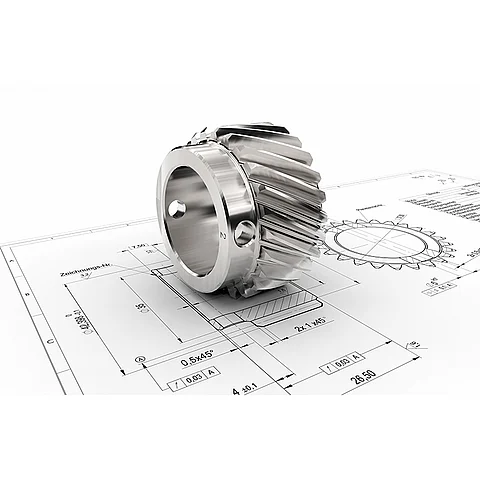
Powder metallurgy
In powder metallurgy, metallic components are produced by shaping and compacting metal powders, followed by sintering. This process is a central component of industrial series production – particularly where the need for machining is to be minimised. Shaping from powder also allows complex geometries to be realised with near-net-shape accuracy. This reduces material waste and shortens process chains.
The process begins with the provision of defined metal powders. Particle size, particle shape, flowability and purity are crucial material parameters. If required, the powders can be mixed with alloying additives, lubricants or binders. This is followed by compaction in extruders, presses, dies or via isostatic pressing.
During the subsequent sintering process, the particles are thermally bonded below their melting point. This produces solid metallic structures with defined porosity. An important area of application is mechanical alloying. Here, different powder components are intensively mixed and deagglomerated. In planetary or high-energy mills, fine mixed crystals and metastable phases form. This enables the realisation of alloying concepts that are not achievable with conventional melting processes.
Mechanical alloying places high demands on mixing technology. The homogeneity of the powder mixture is crucial for the subsequent chemical composition at the micro-scale. This is particularly true when very small quantities of nanodispersed additives are used. These additives should be deposited as completely and uniformly as possible onto the particle surfaces of the other components, without themselves appearing as a particle fraction. This requires mixing technology that, on the one hand, achieves a very high mixing quality and, on the other hand, generates controlled relative motion at the particle surfaces.
amixon® powder mixers are used in powder metallurgy to solve such tasks. They enable even the smallest amounts of nanodispersed additives, down to trace levels, to be applied almost completely to the available particle surfaces of the base components. This allows flow properties, pressing behaviour, sintering kinetics or surface reactivity to be specifically adjusted without unduly damaging the grain structure or promoting segregation.
Powder metallurgy overlaps with other powder-based materials technologies. For example, high-performance ceramics are also produced from fine powders, mixed, shaped and sintered. Here too, tight tolerances for particle size distribution, mixing quality and degree of compaction are crucial. Similar principles apply to hard metals, cermets and functional gradient materials, in which different property profiles are combined within a single component.
 Blog
Blog
 Related pages