

Powder bed
A powder bed is a stationary or moving mass of powder particles in a container or on a surface. It forms when the particles arrange themselves into a pile under the influence of gravity. A powder bed can be operated either open to the environment or sealed gas-tight, for example, in an inert atmosphere. It can be operated at ambient pressure, positive pressure or under vacuum.
The particles form a porous medium with a defined porosity. Gases can flow through the voids. This allows heat to be transferred. Furthermore, mass transfer can take place.
ε = Vvoid/ Vtotal
- Vvoid is the volume between the particles
- Vtotal is the total volume of the powder bed
- ε is the porosity (proportion of void volume, dimensionless)
Numerous process operations can be carried out in a powder bed. These include, for example, mixing, drying, heating, cooling, reacting, agglomerating or calcining. The key factor is that the particles can be regarded as free-flowing bulk material.
Powder beds are found in process engineering plants in a wide variety of forms. Examples include fluidised bed reactors, rotary kilns, silos with pneumatic mixing, mechanical powder mixers, vacuum mixing dryers and coating plants. In additive manufacturing processes (powder bed fusion), for example, the powder bed must be extremely homogeneous.
In a fluidised bed, the powder bed is fluidised from below by a gas flow. The particles then float in a quasi-liquid state and undergo very intense heat and mass transfer. In rotary kilns, the powder bed is mixed by rotation and thermally treated along the length of the kiln.
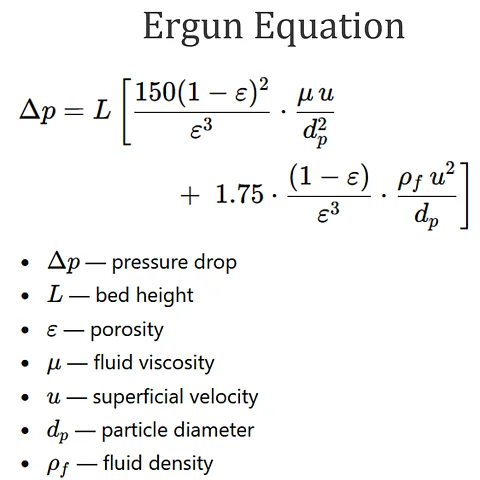
Macroscopically, the powder bed can be described using mass and energy balances. The local temperature distribution, for example, can be modelled using an energy balance incorporating convective and conductive heat transfer. The flow through the porous bed can be approximated using pressure loss equations such as the Ergun equation.
Δp = L · [150·(1−ε)2/ ε3·μ·u/(dp)2+1.75 (1−ε)/ε3·ρf·u2/dp]
- Δp is the pressure drop across the powder bed
- L is the bed length or bulk height in the direction of flow
- ε is the porosity of the bed (see above)
- μ is the dynamic viscosity of the fluid
- u is the superficial (apparent) flow velocity
- dp is the mean particle diameter
- ρf is the density of the flowing fluid
An important process objective is to achieve as homogeneous a distribution of conditions as possible within the powder bed. Temperature, moisture content, composition and particle structure should all ultimately lie within tight tolerances. Only then can the end product be considered homogeneous. A powder treatment is only deemed complete when the powder bed represents such an end product.
 Blog
Blog