
Oxide ceramics
Oxide ceramics are a special form of high-performance or engineering ceramics. They belong to the field of technical ceramics. Their manufacture is based on ceramic powder technology rather than traditional metallurgy. Oxide ceramics consist of high-purity metal oxides. Oxide ceramics include pure oxides as well as mixed oxides and stabilised oxide phases and are characterised by high hardness, wear resistance, chemical resistance and temperature stability.
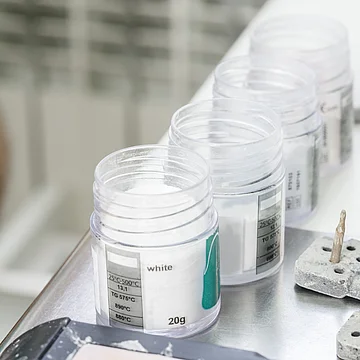
Typical starting materials are aluminium oxide, zirconium oxide, magnesium oxide or yttrium oxide. These powders are finely ground. They are then precisely measured and mixed homogeneously. This is followed by shaping, for example by pressing or injection moulding. Compaction is achieved by sintering at very high temperatures. This produces dense, solid and almost pore-free materials.
Oxide ceramics can have different structures and properties. These depend on the composition, grain size and sintering process. Chemically, oxide ceramics are largely inert. They hardly react with acids, alkalis or solvents. They are also electrically insulating and temperature-resistant.
A key feature is their very high hardness, which significantly exceeds that of steel. Depending on the material, the Vickers hardness can be many times that of tempered steel. This makes oxide ceramics ideal for wear protection.
In practice, they are often applied as a coating to metal components. This is done, among other things, by thermal spraying processes. Typical processes are plasma spraying, high-speed flame spraying or spraying with powder- or wire-filled systems. This creates a firmly adhering ceramic layer on the base material.
If oxide ceramics are used as shaft protection, post-processing is necessary. The coated surface is micro-fine ground and lapped. This creates extremely smooth and very dimensionally stable surfaces. These are often mirror-like. Visually, they are often difficult to distinguish from the metallic substrate. Due to its hardness, wear resistance and chemical resistance, oxide ceramics are a key material in mechanical and plant engineering. They are often used where long service life and low contamination are required.
1. Density and relative density
The degree of compaction achieved is decisive for strength and wear resistance.
Bulk density:
ρ = m / V
- ρ = density
- m = mass
- V = volume
Relative density:
ρrel = ρtheoretical /ρmeasured
In practice, values above 98% are considered to be of high sintering quality.
2. Hardness (Vickers hardness)
Very relevant for wear protection coatings.
HV = 1.854 ⋅ F/d2
- HV = Vickers hardness
- F = test force
- d = mean diagonal of the indentation
Typical values:
- Aluminium oxide: 1,500–2,200 HV
- Steel: 200–800 HV
3. Flexural strength (3-point bending test)
Important for brittle materials such as ceramics.
σB = 3FL/(2bh2)
- σB = flexural strength
- F = breaking force
- L = span
- b = specimen width
- h = specimen thickness
Oxide ceramics typically range from 300–1,000 MPa.
4. Thermal expansion
Important for ceramic coatings on metal.
ΔL = α⋅L0⋅ ΔT
- α = linear thermal expansion coefficient
- L0 = initial length
- ΔT = temperature change
Typical values:
Aluminium oxide: ~8 · 10⁻⁶ /K
Steel: ~12 · 10⁻⁶ /K
→ explains thermal stresses at interfaces.
 Blog
Blog
 Related pages