Oxidation
Oxidation describes a chemical reaction in which a substance releases electrons.
In the classical view, oxidation is often linked to oxygen. Oxygen is a highly reactive element with the atomic number 8. It is present in the atmosphere as a diatomic molecule O2O_2O2. Its volume fraction in the air we breathe is approximately 20.9%.
Due to its high reactivity, oxygen does not occur in nature in its elemental form.
It is almost always chemically bound. Typical binding partners are hydrogen, carbon, metals and non-metals. The existence of flora and fauna on Earth is not possible without oxygen.
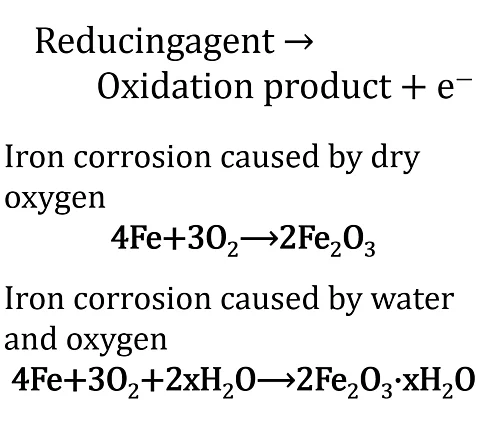
Chemically, oxygen is characterised by high electronegativity. It has a strong oxidising effect. It forms stable oxides. It enables exothermic reactions with high energy release. A general oxidation reaction can be simplified as follows:
Reducing agent → Oxidation product +e−
The following applies to iron corrosion:
4Fe+3O2→2Fe2O3
In modern chemistry, oxidation is generally defined as the transfer of electrons.
The reverse reaction is reduction. Both processes are inextricably linked. These are referred to as redox reactions.
Oxygen plays a central role in medical technology. It is essential for cellular respiration. In biochemistry, it is involved in enzymatic oxidation processes.
In process engineering, it is used specifically for oxidation. In the chemical industry, it serves as a reaction partner or oxidising agent.
At the same time, oxygen is often the driving factor in corrosion. Corrosion is synonymous with the destruction of materials. Metals are particularly affected. In the maritime industry alone, the economic damage is estimated at 50–80 billion US dollars per year.
Corrosion protection is therefore of great importance in mechanical engineering and in the processing of metallic materials. Typical measures include protective coatings, alloy adjustments and the selection of corrosion-resistant materials.
Controlled process atmospheres also help to prevent corrosion. In industrial process engineering, closed mixing and reactor systems are used for this purpose. amixon® systems, for example, enable powders to be mixed, reacted and dried under inert gas or vacuum.
 Blog
Blog