Load cells
Load cells are transducers that convert mechanical forces into electrical signals. In process engineering, they are primarily used to determine mass. The measured force is generated by the weight of a product or piece of equipment and acts as a vertical force on the load cell.
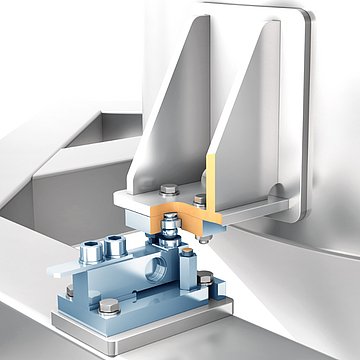
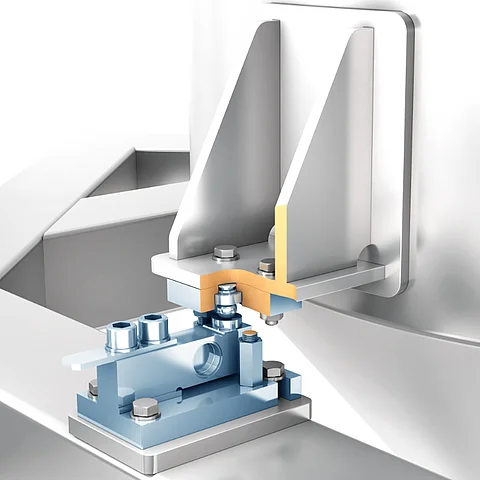
In most applications, load cells are based on the strain gauge principle. An elastic measuring structure undergoes minimal deformation under load. This deformation is detected electrically and converted into a signal proportional to the load. Load cells are used in silos, mixers, dosing systems and containers. They enable the measurement of batch weights, dosing quantities and mass flows. By combining several load cells, even large apparatus can be weighed safely and accurately.
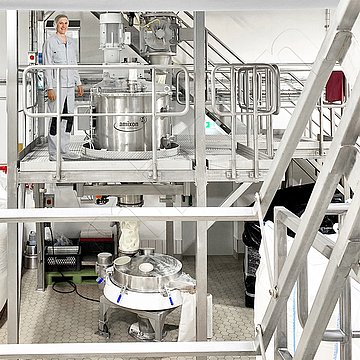
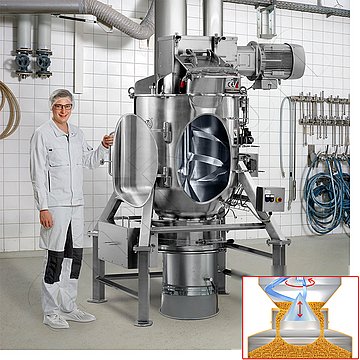
Measurement accuracy depends on the design, resolution, temperature stability and mechanical decoupling. Disturbing forces caused by vibrations, pipe connections or mixing movements must be taken into account in the design. This is the only way to achieve stable and reproducible weighing data. Load cells are a key component of modern process automation. They enable precise dosing, traceability and quality control. amixon® machines offer ideal conditions for weighing using load cells. They generate only minimal vertical vibrations. Furthermore, the machines are torsionally rigid. Their centre of gravity is located almost centrally.
 Blog
Blog