
Liquid bridges
Liquid bridges are capillary connections of liquid that form between solid particles or between a particle and a solid wall. They arise when a small amount of liquid is present in an otherwise gas-filled pore space. Due to wetting and capillary forces, the liquid then forms a meniscus between the solid surfaces.
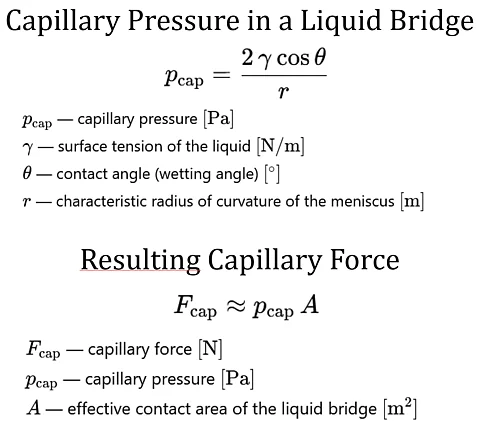
Such liquid bridges generate attractive forces between the solid particles involved. Responsible for this are the capillary pressure and the surface tension of the liquid in combination with the wetting behavior of the solid surface. A commonly used, simplified relation for the capillary pressure in a liquid bridge is:
p_(cap) = 2 * γ * cos(θ) / r
- p_(cap): Capillary pressure in the liquid bridge
- γ: Surface tension of the liquid
- θ: Wetting angle (contact angle)
- r: characteristic radius of curvature of the meniscus
The greater the surface tension, the greater the capillary pressure. Good wetting (small theta, cos(theta) close to 1) further enhances the attraction. The force F_(cap) resulting from p_(cap) on a particle assembly can be approximately estimated from the effective contact area A:
F_(cap) ≈ p_(cap) * A
- F_(cap): Capillary force
- A: Effective contact area of the liquid bridge
In bulk solids, liquid bridges can significantly increase cohesion. Moist powders tend to caking, bridging in silos, and the formation of agglomerates. Depending on the amount of liquid, one distinguishes pendular states (individually formed liquid bridges), funicular networks, and capillary saturation. In practice, liquid bridges play a role in agglomeration, drying, flow problems of moist powders, as well as in the assessment of cleanability and residual adhesions in equipment.
 Blog
Blog