

Humidification results
Wetting results in powder mixers indicate how homogeneously a liquid is distributed within a particle assembly and which microstructures (pendular liquid, capillary bridges, films, saturation) form in the process. A central measure of wettability is the contact angle θθ between the liquid and the solid surface, which is linked to the interfacial tensions via Young’s equation:
γ_SG = γ_SL + γ_LG · cos(θ)
The following applies: θ < 90° → good wetting; θ > 90° → poor wetting.
- γ_SG = interfacial tension solid–gas
- γ_SL = interfacial tension solid–liquid
- γ_LG = interfacial tension liquid–gas
- θ = contact angle
Small contact angles (near 0°) promote rapid and complete wetting of particle surfaces and capillaries, whereas large contact angles lead to delayed penetration and inhomogeneous wetting patterns.
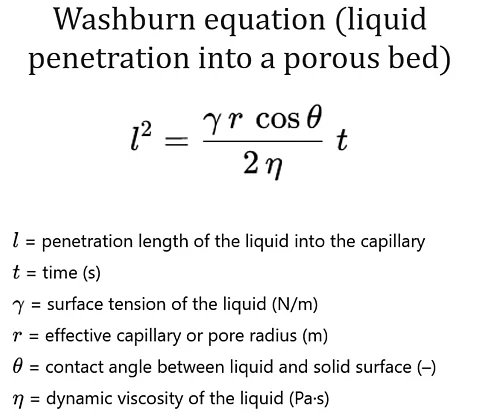
For the dynamics of liquid uptake into a powder bed, the Washburn equation is often used. It links the rise height l of a liquid in a capillary or a porous bed to time t:
l² = (γ · r · cos(θ)) / (2 · η) · t
- l = rise height of the liquid (in m)
- γ = surface tension of the liquid (in N/m)
- r = effective capillary radius (in m)
- θ = contact angle (in °)
- η = dynamic viscosity of the liquid (in Pa·s)
- t = time (in s)
The equation shows that wettability (contact angle θ) and pore structure (capillary radius r) determine the wetting rate. In practice, good wetting results in the powder mixer are achieved when the liquid is finely sprayed in below the bulk material surface, the mixing chamber is sufficiently filled, and the relative velocity of the particles is high enough.