

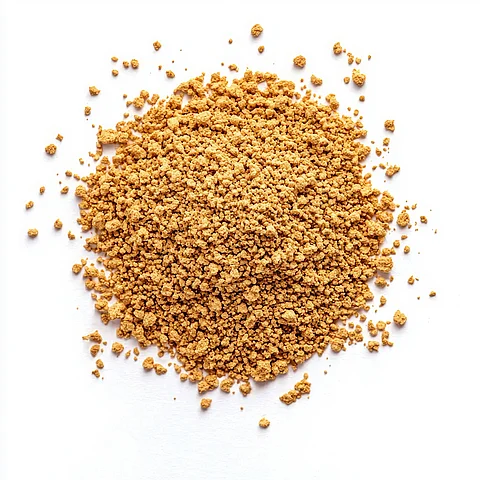
granules
Granulates are solid, mostly granular bulk materials that consist of many individual particles within a relatively narrow size range. They typically occur as grains, pellets, or irregular particles in the millimeter or submillimeter range. Granulates can arise directly during manufacturing, for example through spray or melt granulation, or be produced by targeted build-up granulation in a mixing process.
Important properties of granulates include the particle size distribution, particle shape, bulk density, the strength of the granules, and abrasion behavior. Compared with fine powders, granulates are generally more free-flowing, generate less dust, and can be dosed more precisely. The particle size distribution is often described by characteristic values such as d₁₀, d₅₀, and d₉₀. These indicate the diameters below which 10%, 50%, and 90% of the particles lie.
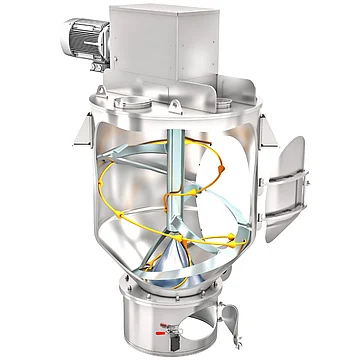
Granulates are found in many industries, for example as plastic granulate, fertilizer, detergent granulate, tablet press granulate, food or feed granulate. They are preferred when powders dust too much, tend to segregate, flow poorly, or are difficult to dose. Granulation also allows bulk density, dissolution behavior, handling, and product stability to be specifically adjusted. As a rule, agglomerated bulk solids are sensitive to abrasion and pressure. When they are involved in mixing processes, the mixer should operate particularly gently. amixon® provides two mixers for this purpose that are particularly well suited: a) the KoneSlid mixer "KS" for batches up to 4 m³ and the twin-shaft mixer "HM".

 FAQ - granules
 Related pages