

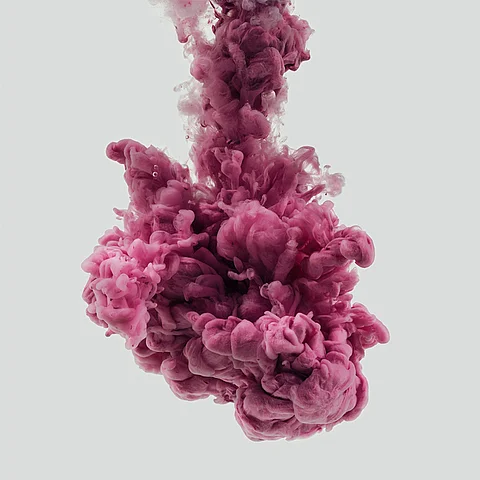
Gas diffusion
In gas diffusion, gas molecules distribute themselves automatically due to their thermal motion. The particles migrate from areas of higher concentration to areas of lower concentration until a concentration equilibrium is established. This process does not require any external flow, but is based solely on the constant, random motion of the gas particles.
In gas mixtures, diffusion causes the different gases to mix with each other, even if there is no macroscopic convection. The diffusion rate is significantly higher in gases than in liquids, as the particle distances are greater and the average particle velocities are higher. In addition to concentration gradients, temperature and pressure gradients can also influence diffusion processes.
Technically, gas diffusion plays a role in many areas, for example in gas exchange in the lungs, in the passage of gases through porous media, in drying, in membrane processes or in special separation processes such as the gas diffusion process for isotope separation. In process engineering, diffusion in gases is often described using the general laws of diffusion, whereas in multi-component mixtures, models such as Maxwell-Stefan diffusion are used.
Gas diffusion is a mass transfer process caused by a concentration gradient. There is no macroscopic flow. The driving force is the concentration gradient. The mass flow density is proportional to the gradient. The minus sign in the formula indicates transport in the direction of decreasing concentration. Fick's law (steady state) is:
J = - D · (dc/dx)
- J = mass flow density
- D = diffusion coefficient
- c = substance concentration
- x = location coordinate