

Fluidised-bed agglomeration
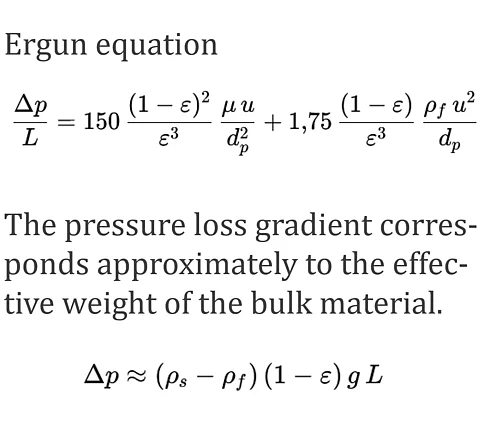
The transition from a stationary fixed bed to a fluidised bed begins when the gas flow rate through the bed equals the weight of the particle bed. This minimum fluidisation condition can be described, in simple terms, by the equilibrium between pressure loss and weight:
Delta_p = (rho_s - rho_g) * g * H
Here, Delta_p is the pressure drop across the particle bed, rho_s is the particle density, rho_g is the gas density, g is the acceleration due to gravity, and H is the bed or layer height. This relationship describes the physical starting point of fluidisation.
For the practical design of fluidised-bed agglomeration, the minimum fluidisation velocity is often determined using the empirical Wen–Yu correlation:
Re_mf = ( (33.7^2 + 0.0408 * Ar)^(1/2) ) - 33.7
Here, Re_mf is the Reynolds number at minimum fluidisation and Ar is the Archimedes number of the particle-gas system. Re_mf can be used to calculate the required gas velocity at which a stable fluidised bed is formed.
During fluidised-bed agglomeration, a binder is sprayed into the fluidised bed of particles. The particles become wetted, adhere to one another and form agglomerates. At the same time, drying takes place via the gas flow. The particle size, porosity and strength of the agglomerates can be precisely controlled.
- Delta_p is the pressure drop across the particle bed (Pa)
- rho_s is the density of the solid particles (kg/m³)
- rho_g is the density of the gas (kg/m³)
- g is the acceleration due to gravity (m/s²)
- H is the height of the particle bed (m)
- Re_mf is the Reynolds number at minimum fluidisation (–)
- Ar is the Archimedes number (–)