

Explosive
The property of a substance or mixture of substances to release energy abruptly under certain conditions is referred to as "explosive." This energy conversion proceeds very quickly and is accompanied by a strong increase in pressure, heat generation, and often flame formation. Typical triggers are ignition by sparks, flames, hot surfaces, impact, friction, or electrostatic discharges.
In the process engineering context, one speaks of explosive atmospheres when flammable gases, vapors, or dusts form an ignitable mixture with air. For many organic dusts (for example flour, sugar, starch, plastics, or pharmaceutical active ingredients), even small layer or suspended fractions in combination with an ignition source can lead to dust explosions. In this context, characteristic parameters such as minimum ignition energy, lower and upper explosion limit, maximum explosion pressure, and rate of pressure rise are decisive.
In and around mixers as well as conveying and filling systems, the assessment of explosive risks is particularly important. Here, dusty products, air, and possible ignition sources (mechanical sparks, hot bearings, electrical components, electrostatic discharge) can come together in close proximity. However, an explosive atmosphere exists only when the concentration, oxygen content, and temperature lie within a critical range.
Technical control of explosive hazards includes, for example, avoiding ignitable atmospheres (for example by inerting), limiting dust release, effective grounding and equipotential bonding to prevent electrostatic sparks, the use of suitable electrical equipment, constructive explosion protection (for example pressure relief and explosion suppression), as well as organizational measures. In the planning and design of mixing processes, it should therefore be examined whether the respective product or the product-air mixture is to be classified as explosive and which protective measures are required.
Concentration limits are often used to describe an explosive gas‑, vapor‑, or dust-air mixture. A simple notation is:
c_untere_EG ≤ c_Stoff ≤ c_obere_EG
- c_Stoff: concentration of the combustible substance in air
- c_untere_EG: lower explosion limit (UEG)
- c_obere_EG: upper explosion limit (OEG)
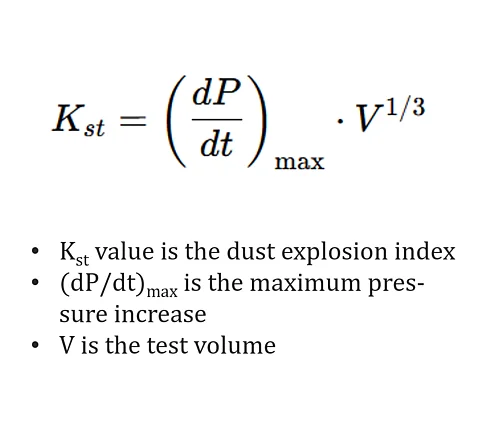
In safety assessments, a safety-related characteristic value, the so-called K_ST (for dusts) or K_G (for gases), is often used. For dusts, a frequently specified relationship is:
K_ST = (dp/dt)_max · V^(1/3)
- K_ST: dust explosion constant [bar·m/s]
- (dp/dt)_max: maximum rate of pressure rise in the vessel [bar/s]
- V: volume of the test vessel [m³]
 Blog
Blog