

Evaporation
Evaporation refers to the slow transition of a liquid into the gaseous phase at a temperature below its boiling point. This process takes place exclusively at the free surface of the liquid. Individual molecules leave the liquid when their kinetic energy is sufficient to overcome the intermolecular forces.
Evaporation is a continuous mass transfer process. It is influenced by temperature, air movement, pressure and relative humidity. High temperatures and low humidity accelerate evaporation. A drop in ambient pressure also increases the rate of evaporation.
The temperature of the liquid surface is crucial for evaporation. It determines the local vapour pressure at saturation. Evaporation is therefore a coupled process of heat and mass transfer. A decrease in ambient pressure or an increase in temperature significantly increases the rate of evaporation.
Unlike boiling, evaporation takes place without the formation of bubbles within the liquid. It is a surface phenomenon. In industrial drying processes, evaporation is often the second step following mechanical dehumidification.
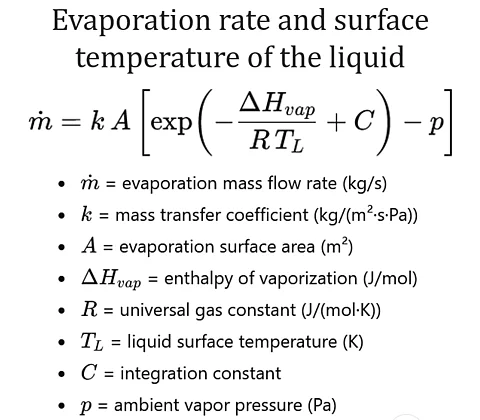
The evaporation rate can be described by:
m˙ = k · A · [exp ( −ΔH_vap / (R · T_L ) + C )−p]
- m˙ is the evaporation rate (kg/s)
- k is the mass transfer coefficient
- A is the evaporation area (m²)
- ΔH_vap is the enthalpy of vaporisation (J/mol)
- R is the universal gas constant (J/(mol·K))
- T_L is the temperature of the liquid surface (K)
- C is the molar mass
- p is the vapour pressure of the process environment (Pa)
Evaporation plays an important role in drying, cooling, heat pumps, coating and solvent separation.