
Evaporate, boil down
During evaporation, a solution is heated until the solvent has evaporated and the nonvolatile fraction has been enriched or completely separated as a solid. The colloquial term for the same process is boiling down, especially when viscous concentrates are produced.
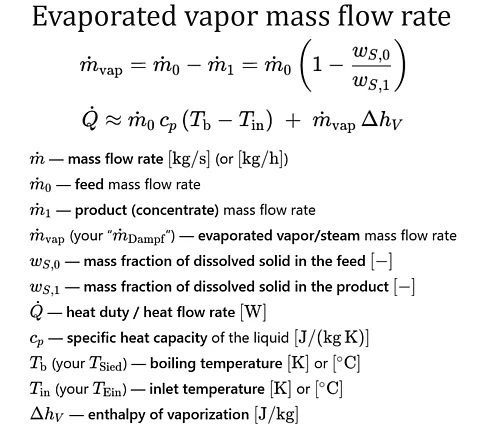
For a simple mass balance between feed (0) and concentrated product (1), the following applies:
ṁ_0 = ṁ_1 + ṁ_Dampf
ṁ_0 · w_S,0 = ṁ_1 · w_S,1
The heat required for evaporation consists (highly simplified) of sensible heating and latent heat of vaporization:
Q̇ = ṁ_0 · c_p · (T_Sied − T_Ein) + ṁ_Dampf · Δh_V
Here, c_p is the heat capacity, T_(Sied) the boiling temperature, T_(Ein) the inlet temperature, and Δh_V the enthalpy of vaporization.
Meaning of the symbols:
- m_0̇: Mass flow rate of the feed
- m_1̇: Mass flow rate of the concentrated product
- m_Dampḟ: Mass flow rate of vaporized solvent
- w_S,0: Mass fraction of solids in the feed
- w_S,1: Mass fraction of solids in the product
- Q̇: Heat rate
- cp: specific heat capacity of the liquid/solution
- T_Sied: Boiling temperature in the apparatus
- T_Ein: Inlet temperature of the solution
- Δ_hV: Enthalpy of vaporization of the solvent
In equipment such as amixon® mixing and drying systems, the liquid can be efficiently removed by evaporation. Optionally also under vacuum. Afterwards, the residual moisture is further reduced by drying until a free-flowing powder is formed. Here, in addition to thermodynamics (boiling point, enthalpy of vaporization), changing material consistencies (liquid, highly viscous, semi-solid, powdery) also play a role. This approach avoids low fill levels in the vacuum mixer-evaporator.
 Blog
Blog