

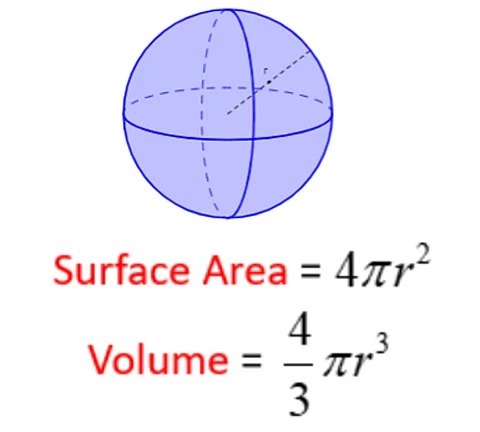
Equivalent diameter based on the sphere
Different equivalent diameters are used depending on the measurement method and the question being asked. The equivalent sphere diameter (de) is a measure of the shape of particles. Since real particles are rarely perfect spheres, this value is used. It refers to the diameter of a hypothetical sphere that corresponds to the real particle in terms of a defined property (e.g. volume or surface area).
dv = (6·VP / π)(1/3)
This definition is particularly relevant for volume-based measurement methods such as laser diffraction and for questions where the particle volume per mass or amount of substance is decisive.
Surface equivalent sphere diameter: Let the surface area of any particle be AP. The surface equivalent sphere diameter da is defined such that the surface area of the particle corresponds to the surface area of a sphere.
da = (AP / π)(1/2)
This definition is important when surface-dependent phenomena are in the foreground, such as solution and reaction kinetics or adsorption on the particle surface.